AG1 Is Excellent. It Is Also a Luxury Product.
There is a useful way to think about AG1 that avoids both extremes of the usual online debate: it is neither a miracle powder nor simply an overpriced collection of vitamins, but rather a carefully designed convenience product that combines a large number of nutritional categories into one daily habit, wraps them in quality control and extremely effective marketing, and charges a significant premium for doing so.
For someone who values simplicity above almost everything else, that can be a perfectly rational purchase. You open one pouch, mix one scoop, and outsource much of the decision-making around vitamins, minerals, greens, probiotics, digestive support and various functional ingredients.
The problem begins when convenience is confused with necessity.
For European consumers in particular, AG1 can become an expensive way of purchasing nutritional components that are often available separately through pharmacies, drugstores and established supplement brands at dramatically lower prices.
“What exactly are we paying for, which components matter to us, and how much would it cost to assemble those functions separately?”
Start by opening the black box
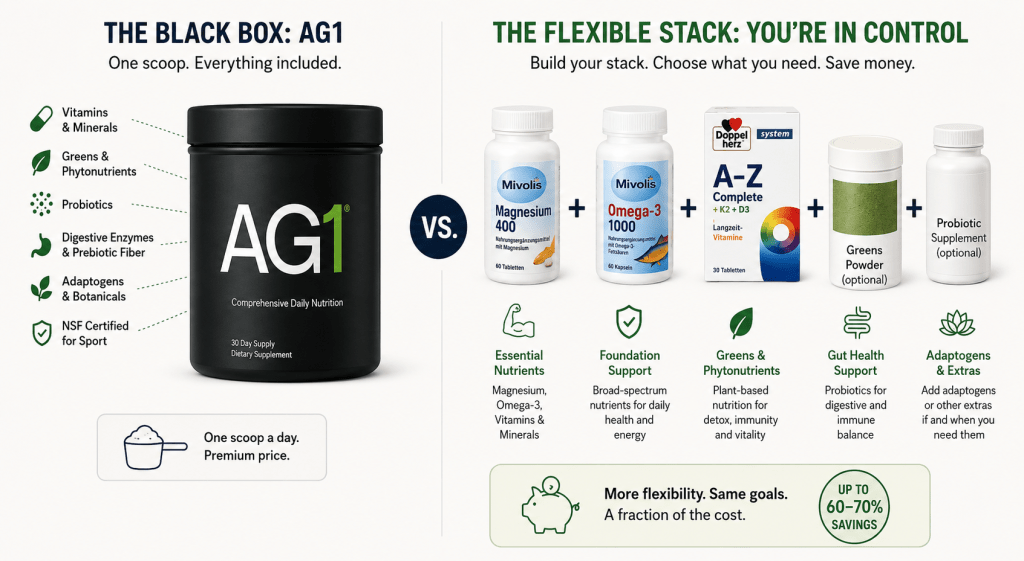
AG1 is recommended by health references such as Tim Ferris and Andrew Huberman combines more than 70 ingredients, but the number itself makes the product sound more complicated than it really is. From a consumer perspective, the formula can be separated into a relatively small number of functions.
The first is a broad multivitamin and mineral foundation. The second is greens and plant-derived phytonutrients. The third is probiotic support. The fourth is digestive support through enzymes and prebiotic ingredients. Finally, there are adaptogens and functional ingredients such as ashwagandha, rhodiola and mushroom extracts.
This bundling is where AG1 is genuinely strong. Instead of researching and purchasing multiple products, you obtain most of these categories in a single scoop, with the additional comfort of manufacturing standards and sports certification.
But bundling inevitably reduces flexibility.
When dozens of ingredients appear in a combined formula, consumers have less control over individual components and doses. If you want more of one ingredient but less of another, you cannot simply modify the formula.
A modular alternative reverses that logic.
Instead of trying to find a cheaper powder containing exactly the same long ingredient list, identify the functions that matter and purchase those components separately.
Table 1 — AG1 versus modular stack
| Function | AG1 | Modular European option | Main difference |
|---|---|---|---|
| Vitamins & minerals | Integrated into formula | Doppelherz A–Z or equivalent | Modular dose and brand choice |
| Magnesium | Included within formula | Mivolis Magnesium 400 | Separate product |
| Omega-3 | Can be managed separately | Mivolis Omega-3 1000 or higher EPA/DHA alternative | Easier to choose EPA/DHA level |
| Greens & phytonutrients | Integrated greens blend | Nature Love Green Superfood | Separate, transparent category |
| Probiotics | Integrated probiotic component | Nature Love Probiona / Mivolis Darm Plus | Choice of price and specification |
| Digestive support | Integrated enzymes/prebiotic ingredients | Add separately if desired | Optional rather than automatic |
| Adaptogens | Included in broader blends | Select individually if desired | Greater control |
| Certification | Premium quality/certification positioning | Depends on individual manufacturer | AG1 advantage |
| Convenience | One scoop | Several products | AG1 advantage |
| Flexibility | Limited | High | Modular advantage |
A European experiment: build the stack from dm
This approach can be applied in any region and Europe provides an interesting test case because chains such as dm make basic supplements inexpensive enough that the economics become immediately visible.
A simple foundation can start with magnesium, omega-3 and a broad multivitamin/mineral product. Using products from Mivolis and Doppelherz as an illustration, this basic foundation costs only a small fraction of an imported premium greens product.
Of course, this is not yet an AG1 substitute. The basic stack does not automatically include greens, probiotics, digestive enzymes or most adaptogens.
But this is precisely where the modular approach becomes interesting. If you want greens, add greens. If you want a probiotic, add a probiotic. If you specifically want an adaptogen, choose one separately and look at its actual formulation. If you do not need one of those categories, do not buy it.
This is less elegant than a single scoop every morning, but considerably more transparent and flexible.
Greens: simple versus comprehensive
A product such as Nature Love Green Superfood illustrates the simpler approach. Instead of trying to become another complete multivitamin, it concentrates largely on plant powders and related ingredients such as spirulina, moringa, barley grass, spinach, kale and broccoli, together with mushroom ingredients such as reishi and chaga.
At the indicative prices used for this comparison, the cost works out at roughly €0.60 per day.
Doppelherz Grünes Superfood takes the opposite approach and incorporates a much broader collection of ingredients, including chlorella, wheatgrass, matcha, grape-seed compounds, ashwagandha, ginseng, reishi, coenzyme Q10 and enzymes, together with additional vitamins and minerals.
The broader product offers greater convenience, but it also raises an obvious question: if you already take an A–Z multivitamin, do you really want another product containing many of the same micronutrients?
The lesson is broader than this individual comparison.
Every time we increase convenience, we tend to give up some precision.
Table 2 — Greens comparison
| Feature | Nature Love Green Superfood | Doppelherz Grünes Superfood |
|---|---|---|
| Main ingredients | Spirulina, moringa, barley grass, spinach, kale, broccoli, reishi, chaga, inulin, pea protein | Spirulina, chlorella, wheatgrass, matcha, grape seed, ashwagandha, ginseng, reishi, Q10, bromelain, papain plus vitamins/minerals |
| Indicative daily cost | ~€0.60 | ~€1.50 |
| Nutritional approach | Primarily plant powders and fiber | Broader all-in-one formulation |
| Main advantage | Simpler and inexpensive | More comprehensive |
| Main drawback | Fewer added functional ingredients | Potential overlap with a multivitamin |
| Best suited to | Modular stack | Consumer wanting greater convenience |
Probiotics: where modularity becomes particularly useful
The same logic applies to probiotics, where products can differ substantially in price, number of strains, declared CFU count and formulation.
Nature Love Probiona represents the more comprehensive option in this comparison, while Mivolis Darm Plus provides an extremely inexpensive entry-level alternative. BitterLiebe offers another approach in liquid fermented form.
There is no reason why the choice of probiotic has to be dictated by the choice of multivitamin or greens powder.
That is one of the advantages of separating the components.
You can spend more in the categories you consider important and very little—or nothing—in categories you do not.
Table 3 — Probiotic comparison
| Product | Approx. monthly cost | Main characteristics | Best suited to |
|---|---|---|---|
| Nature Love Probiona | ~€18 | 20 strains, 20B CFU, microencapsulated | More comprehensive probiotic option |
| Mivolis Darm Plus | ~€2 | Basic inexpensive probiotic | Budget-oriented everyday use |
| BitterLiebe Probio Liquid | ~€5.45 | Fermented liquid format | Consumers preferring liquid products |
Three possible ways to build the stack
Once the individual pieces are separated, the financial comparison becomes more interesting.
Option 1 — The essential modular stack
A simple combination of magnesium, omega-3 and a broad multivitamin can come to approximately:
€16–22 per month
This is not a literal AG1 replacement. It is the inexpensive foundation. Greens, probiotics, digestive enzymes and most adaptogens are missing. Depending on diet and individual objectives, some consumers may decide that this is enough.
Option 2 — The balanced modular stack
Now add a greens product and an inexpensive probiotic.
Using approximately €18 per month for greens and €2 for the basic probiotic, the complete monthly cost becomes roughly:
€36–42 per month
Against an assumed AG1 cost of approximately €100–120 per month, the difference becomes significant.
At a midpoint of €39 per month for the modular system versus €110 for the premium all-in-one system:
Monthly difference: €71
Annual difference: €852
Once recurring costs are viewed annually rather than one purchase at a time, the economics become much easier to see.
Option 3 — The more complete modular stack
Now replace the inexpensive probiotic with the more comprehensive Nature Love Probiona option.
Using our indicative numbers:
Foundation: approximately €16–22 per month
Greens: approximately €18 per month
Premium probiotic: approximately €18 per month
Total:
Approximately €52–58 per month
| Strategy | Approx. monthly cost | Approx. annual cost |
|---|---|---|
| Essential modular stack | €16–22 | €192–264 |
| Balanced modular stack | €36–42 | €432–504 |
| More complete modular stack | €52–58 | €624–696 |
| AG1 illustrative range | €100–120 | €1,200–1,440 |
AG1 at €100 per month: €1,200 per year
Modular stack at €56 per month: €672 per year
Difference: €528 per year
If the premium product costs closer to €120 per month, the comparison becomes: €1,440 per year versus €672
Difference: €768 per year
The purpose of this calculation is not to argue that the cheapest supplement strategy must always be the best one.
The interesting point is that supplementation is a recurring expense, and recurring expenses deserve the same scrutiny we apply to investment-management fees, insurance premiums and subscriptions.
A €50 or €70 monthly difference feels relatively small. A €600–€850 annual difference looks different. Over ten years, before considering any return earned on the money saved, it becomes several thousand euros.
So why buy AG1 at all?
Because convenience has real value.
Optimization discussions sometimes assume that every premium is irrational, but that ignores one of the most important variables in any health protocol:
adherence.
The cheapest supplement is worthless if you never take it.
For someone whose scarcest resource is time or attention rather than money, paying a substantial premium to eliminate friction can therefore be perfectly reasonable.
What would be harder to justify is assuming that the premium price means that the underlying nutritional components are uniquely inaccessible elsewhere.
A significant part of what the consumer is purchasing is not ingredients.
It is integration and convenience.
The black box versus the flexible stack
This distinction may ultimately be more important than the precise price comparison.
With an all-in-one product, you buy the complete package. If you decide that you no longer want one category, you cannot simply remove it. If you want to change one particular nutrient after reviewing your diet or blood work, you have limited flexibility. A modular system works in the opposite direction.
The sensible conclusion is somewhere in the middle
AG1 can be an excellent product, particularly for someone who values simplicity and is willing to pay for it.
But it is also a luxury implementation of nutritional functions that can, to a considerable extent, be purchased separately.
For European consumers with access to inexpensive German pharmacy and drugstore products, a modular approach makes the comparison particularly interesting: start with the nutritional categories that actually matter to you, add greens or probiotics if you want them, avoid unnecessarily duplicating vitamins across several products, and reserve expensive or more experimental additions for situations where there is a clear reason to use them.
The wider principle applies far beyond AG1:
Principles are few; products are many.
Understand the function first.
Then decide how much convenience you are willing to pay for.
Appendix
Important note

Supplement requirements vary with diet, age, medications, health conditions and laboratory results. A modular stack is not automatically risk-free, and combining several individual products can create duplicate or excessive doses just as easily as an all-in-one formula can.


People taking prescription medication, managing significant medical conditions, preparing for surgery or considering high-dose supplementation should review their complete supplement use with an appropriate healthcare professional.

Prices in this article are illustrative examples and should be checked again before purchasing.

