The Longevity Supplement That Started the Modern Debate
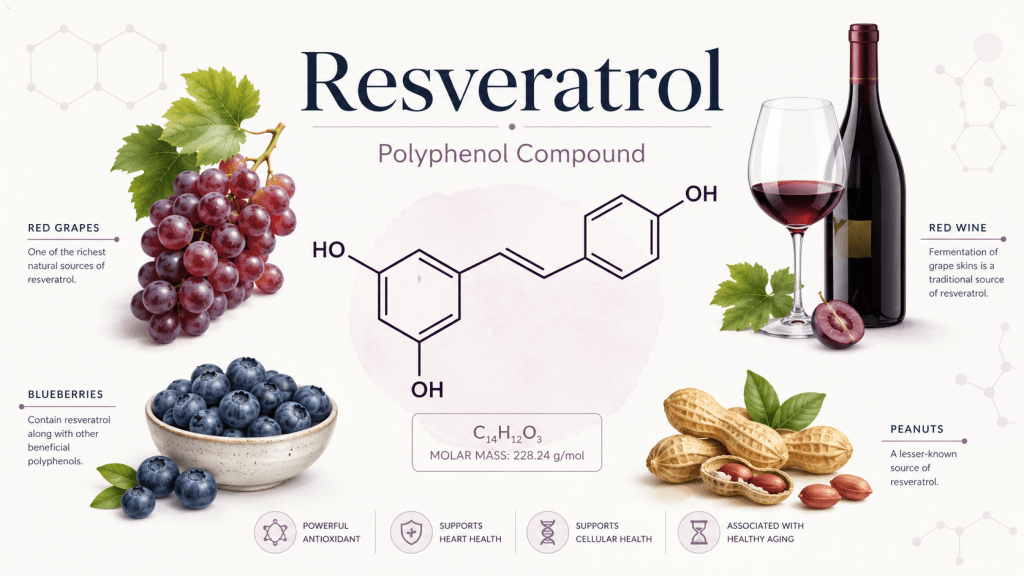
Resveratrol is in some respects the original modern longevity supplement: a naturally occurring polyphenol found in grapes, berries, peanuts and other plants that moved from laboratory research into newspapers, podcasts, supplement cabinets and eventually large numbers of human clinical trials, largely because early work suggested that it could influence biological pathways associated with calorie restriction, mitochondrial function and sirtuins.
Twenty years ago, the mechanism looked compelling enough that it was tempting to extrapolate directly from cells and animals to humans. Today, after far more clinical research, the picture is simultaneously more interesting and less dramatic: there are biological effects, there are positive results in certain populations and endpoints, and there is enough evidence to justify continued research, but there remains no convincing evidence that swallowing resveratrol extends human lifespan.
How resveratrol became a longevity icon
David Sinclair’s laboratory played an important role in the scientific discussion around sirtuins and resveratrol, including research examining the relationship between SIRT1 activation, mitochondrial biology and metabolic function.
But the current scientific conversation is much less enthusiastic than the early longevity narrative. Andrew Huberman, for example, has explicitly said that while resveratrol may have some health effects, he is not aware of direct evidence that it increases human lifespan and does not consider it a top-priority longevity supplement.
What have the human trials actually found?
One of the studies that helped sustain interest was a 2011 randomized crossover trial in 11 obese men who received 150 mg of resveratrol daily for 30 days. Researchers observed several changes consistent with calorie-restriction-like metabolic effects and changes involving mitochondrial function, making the trial influential despite its very small sample.
But subsequent studies did not simply reproduce those results. Recently, a 2026 randomized trial involving 99 overweight or obese adults tested 500 mg per day for 12 weeks with a particular interest in cognition, the gut microbiome and inflammatory/metabolic pathways. The study found no significant resveratrol advantage across the microbiome, adiposity, inflammatory or oxidative biomarkers studied, and the cognitive data did not support the hypothesized benefit.
Perhaps the most useful high-level assessment comes from a 2024 systematic review that examined the resveratrol clinical literature across roughly two decades: close to 200 studies had investigated at least 24 indications, yet the authors concluded that there was still no conclusive clinical evidence sufficient to recommend resveratrol for a healthcare indication, even though certain inflammatory and metabolic outcomes remained encouraging.
It is a heavily studied supplement whose clinical signal remains heterogeneous.
The brain-health question
Resveratrol is often presented as a neuroprotective compound on the basis of vascular, inflammatory, antioxidant and metabolic mechanisms.
There are reasons to continue investigating those pathways, but the 2026 overweight/obesity trial is a useful warning against assuming that mechanistic plausibility will necessarily translate into measurable improvements in cognition. In that study, 12 weeks of 500 mg daily did not produce the predicted cognitive or underlying biological improvements.
Research continues, including clinical work focused on cerebrovascular and cognitive outcomes, which may ultimately identify specific patient populations in which resveratrol is more useful than it is for healthy consumers. For now, we would place it above purely speculative compounds but well below interventions with established brain-health outcome data.
Availability: America, Europe and Asia
United States
Resveratrol is readily marketed within the US dietary-supplement framework, which FDA regulates differently from conventional medicines. This means a resveratrol supplement being legally marketed should not be interpreted as FDA approval of an anti-ageing, cardiovascular or cognitive indication.
European Union
Resveratrol has a much clearer European regulatory history than NMN.
The European Commission authorized specified trans-resveratrol as a novel food ingredient in 2016 for adult supplements under defined conditions, initially with a maximum dose of 150 mg per day for the specified synthetic trans-resveratrol, and the substance subsequently entered the EU Union-list framework.
The authorization also illustrates why European consumers should pay attention to the exact ingredient specification, production method, formulation and label rather than simply purchasing the largest milligram number advertised on an American website.
Asia
Again, there is no pan-Asian supplement regime. Japan has a formal system for Foods with Function Claims in which manufacturers submit safety and evidence documentation before marketing a functional claim, but the Consumer Affairs Agency explicitly explains that this is not the same as the government independently evaluating and approving the safety and efficacy of every product.
The sensible rule when importing from Japan, China or another Asian market is therefore the same one that applies to American products: evaluate the exact ingredient, certificate of analysis and destination-country rules rather than assuming that availability equals approval.
Which format provides the best value?
For the consumer who wants the most straightforward capsule format, Therascience’s 150 mg trans-resveratrol presentation is attractive because the dose, production method and precautions are explicit, although Swiss pricing makes it a premium solution.
For the cost-sensitive consumer evaluating raw ingredient economics, MoleQlar’s 30 g product at roughly €29.90 demonstrates just how inexpensive high-purity trans-resveratrol has become—approximately €1 per gram at that retail snapshot.
At 150 mg per day purely as a cost illustration, 30 grams represents 200 such quantities and roughly €55 of material per year at that price.
But again, this is economics, not a personal dosing instruction.
The more important observation is that, unlike many expensive longevity interventions, the cost of the molecule is no longer the major obstacle.
The weak link is the certainty of the benefit.
What about combining resveratrol with NMN?
The combination became popular because the mechanistic story is elegant: raise NAD availability with a precursor such as NMN, then combine this with a compound associated with sirtuin biology.
MASI currently markets regimens combining NMN and resveratrol, so the combined concept remains commercially available, but a convenient bundle should not be confused with evidence that the combination produces additive longevity benefits in humans.
How long has resveratrol been “in service”?
This is where resveratrol has an advantage over NMN.
Researchers have been conducting human resveratrol trials for roughly two decades, and the literature now includes studies lasting months and, in the RESHAW program, a 24-month crossover intervention. A 2024 systematic review identified close to 200 clinical studies across at least 24 indications.
That provides much more human exposure data than exists for NMN. Yet after all that research, there is still no consensus clinical indication and no human lifespan result.y.
Value conclusion
Resveratrol belongs somewhere between “basic supplement” and “biohacking speculation.”
- The biological story is credible.
- The human research is substantial.
- The compound is relatively inexpensive.
But the expected benefit for a healthy individual remains uncertain, and the grand claim that made resveratrol famous—meaningful extension of human lifespan—has not been demonstrated.
For that reason, we would not build a longevity budget around expensive resveratrol bundles.
For a European consumer who chooses to experiment with it after considering medications and health conditions, the rational approach is a transparent trans-resveratrol product with documented purity, straightforward European dosing and a low recurring cost, rather than assuming that a 500 mg or 1,000 mg American product is better simply because the number on the bottle is larger.
Resveratrol’s future may ultimately be much more interesting in specific clinical populations and specific outcomes—vascular function, metabolic dysfunction, bone health or perhaps particular neurological conditions—than as a universal anti-ageing pill.
After twenty years of trials, that is not a disappointing conclusion.
Research results at a glance
Strongest conclusion: there is extensive human research, but no demonstrated extension of human lifespan and no consensus indication for routine medical use.
Positive signals: certain metabolic, vascular, inflammatory and bone-health outcomes have improved in selected trials and populations.
Important negative evidence: several randomized studies have failed to reproduce broad metabolic benefits, including trials in healthy postmenopausal women, type 2 diabetes and, most recently, overweight adults studied for cognition and gut/inflammatory outcomes.
Practical implication: resveratrol remains scientifically interesting, relatively inexpensive and worthy of further research, but its place in an individual’s longevity budget should reflect uncertainty about the magnitude of real-world benefit.
Selected bibliography
- Timmers S. et al. Calorie restriction-like effects of 30 days of resveratrol supplementation on energy metabolism and metabolic profile in obese humans. Cell Metabolism, 2011.
- Yoshino J. et al. Resveratrol supplementation does not improve metabolic function in nonobese women with normal glucose tolerance. Cell Metabolism, 2012.
- Bo S. et al. Six-month randomized controlled study of 40 mg and 500 mg/day resveratrol in 192 people with type 2 diabetes. Pharmacological Research, 2016.
- Wong R.H.X. et al. RESHAW randomized crossover trial of 75 mg trans-resveratrol twice daily and bone-health outcomes in postmenopausal women.
- Brown K. et al. Resveratrol for the Management of Human Health: How Far Have We Come? A Systematic Review of Resveratrol Clinical Trials to Highlight Gaps and Opportunities. International Journal of Molecular Sciences, 2024.
- Wightman E. et al. The effects of 12-weeks resveratrol supplementation on cognition, gastrointestinal microbiota, and systemic inflammation in an overweight and obese human population. Frontiers in Nutrition, 2026.
- European Commission. Commission Implementing Decision (EU) 2016/1190 concerning trans-resveratrol as a novel food ingredient.

