One of Longevity’s Most Interesting Molecules
NMN, or nicotinamide mononucleotide, occupies an unusual position in the longevity world because it sits at the intersection of an extremely compelling biological mechanism, a growing collection of human trials, prominent scientists and podcasters who have experimented with it personally, and a regulatory environment that is still trying to catch up with a consumer market that moved much faster than the science.
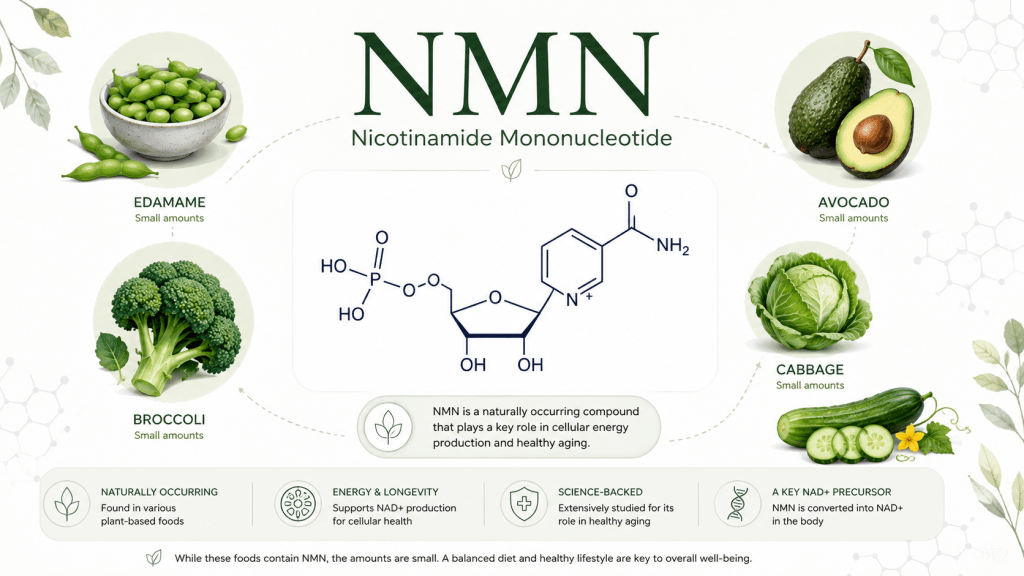
NMN is a precursor in the production of NAD+, a molecule involved in cellular energy metabolism and many fundamental biological processes, and because NAD metabolism has become an important area of ageing research, the idea that restoring or maintaining NAD availability might help preserve aspects of physiological function with age has generated enormous interest. Human studies now show fairly convincingly that orally administered NMN can alter NAD-related biomarkers, but the much bigger question—whether doing this actually produces meaningful improvements in healthspan, brain function or lifespan—remains unresolved.
From longevity celebrity to clinical research
David Sinclair’s laboratory helped bring NAD biology and compounds such as NMN and resveratrol into the mainstream longevity discussion, while Sinclair has publicly described NMN use within his family and repeatedly emphasized that such personal protocols are not clinical trials or prescriptions. His laboratory continues to investigate NAD biology, including substantial preclinical work on NMN.
Andrew Huberman has also publicly discussed using NMN and NR, but his position is considerably more nuanced than many supplement advertisements suggest: he has said that he uses them because of his subjective experience of sustained energy and their relationship to NAD, while explicitly stating that he does not take them because he believes the existing evidence proves that they extend human lifespan.
Peter Attia approaches the same field from an even more skeptical angle, arguing that the popularity of NAD therapies makes it especially important to separate mechanistic plausibility and marketing from demonstrated clinical benefit.
It is no longer merely an interesting mouse experiment, but neither is it an established longevity therapy.
What has actually been demonstrated in humans?
The first important point is that the human evidence is now much larger than it was five years ago, but most trials remain relatively small and short.
One randomized trial using 250 mg per day in women with prediabetes found improved skeletal-muscle insulin sensitivity and changes in NAD-related metabolism, although improvements were not universal across metabolic outcomes. Subsequent trials have reported increases in blood NAD or NAD metabolites, but the magnitude and consistency of those increases depend in part on dose, formulation, tissue sampled and analytical method.
A multicentre randomized study of 80 healthy middle-aged adults tested 300, 600 and 900 mg per day for 60 days. Blood NAD measures increased in a dose-dependent manner and walking-test performance improved relative to placebo, while HOMA-IR—an estimate of insulin resistance—did not improve significantly between treatment and placebo groups. Adverse events were mild or moderate, with none attributed to NMN during the trial.
Another controlled safety study administered 1,250 mg daily for four weeks to 31 healthy adults and found no clinically meaningful changes outside normal physiological variation in the measured clinical parameters. This is reassuring for short-term tolerability, but four weeks of safety data should not be confused with evidence about taking NMN every morning for ten or twenty years.
Across the human literature, researchers have also reported isolated positive findings involving aerobic capacity, lower-limb function, sleep-related outcomes and subjective health measures, while other endpoints have been neutral or inconsistent. A 2024 systematic review and meta-analysis examining 12 studies and 513 participants concluded that whether NMN improves metabolic health remains uncertain.
NMN can influence human NAD metabolism, appears reasonably well tolerated over the relatively short periods studied, and has generated some encouraging functional signals, but we do not yet have evidence that routine supplementation prevents dementia, cardiovascular disease or other age-related disease, nor that it extends human lifespan.
That is a much less exciting statement than an anti-ageing advertisement, but scientifically it is considerably more useful.
Brain health: promising biology, limited human proof
The brain-health argument for NMN is particularly attractive because neuronal function is energetically demanding and NAD biology intersects with mitochondrial function, vascular biology and cellular repair, while preclinical research has produced encouraging effects on neurovascular function and cognition in aged animals. Sinclair’s laboratory, for example, has published work showing improved neurovascular coupling and cognitive measures in aged mice following NMN supplementation.
At present, evidence that NMN supplementation preserves cognition or prevents neurodegenerative disease in humans is insufficient, so from our perspective this belongs in the category of promising and increasingly researched, rather than core brain-health expenditure.
The regulatory map: America, Europe and Asia
United States
The American position changed substantially in late 2025. FDA documents show reinstatement of New Dietary Ingredient notifications involving NMN, and additional NMN notifications continued through 2026, bringing NMN back within the US dietary-supplement pathway after years of regulatory uncertainty. US dietary supplements nevertheless operate under a different regulatory framework from approved medicines; inclusion in the supplement market is not an FDA finding that NMN treats ageing or prevents disease.
European Union
Europe is currently more complicated.
NMN has been classified within the EU Novel Food framework. In May 2026, EFSA published a positive scientific opinion on a specific chemically synthesized β-NMN ingredient proposed for adult food supplements at up to 300 mg per day, excluding pregnant and breastfeeding women. EFSA concluded that the ingredient was safe under the proposed conditions.
However, an EFSA safety opinion is not the same as final market authorization. EFSA performs the scientific assessment; European Commission authorization and inclusion in the Union list are separate regulatory steps.
That point is particularly important because some German sellers openly sell NMN while simultaneously describing it as a chemical raw material rather than a dietary supplement.
United Kingdom
The UK operates its own novel-food process after Brexit, and the Food Standards Agency has an NMN application under assessment rather than treating the ingredient as an ordinary long-established food supplement.
Switzerland
Swiss consumers should likewise distinguish between being able to order a product from a European website and the product being formally authorized for use as a food supplement under the relevant Swiss/EU novel-food framework. In practical terms, this makes NMN a category where regulatory status should be checked again at the moment of purchase rather than assumed from website availability.
Asia
There is no meaningful single “Asian” regulatory regime. Japan has been particularly active in NMN research, with NMN trials and systematic-review projects registered through official Japanese clinical-research systems, while Japan’s functional-food regime relies partly on manufacturer notifications and does not mean that the government has independently validated every efficacy claim. China operates a separate health-food ingredient and registration system.
European consumer comparison — August 2026 snapshot
| Product | Preparation / quality | Price snapshot | Advantages | Limits, risks and regulatory issue |
|---|---|---|---|---|
| Age Science NMN | 50 g powder; stated 99.9% purity; ISO-17025 laboratory testing | €39.90 / 50 g ≈ €0.80/g | Outstanding raw-material price; transparent purity documentation | Crucially, Age Science itself states that its NMN is a chemical raw material and not intended for human consumption in Germany/Europe; therefore this is a value benchmark, the current EU supplement recommendation. |
| MoleQlar Uthever NMN | Powder; >99% stated purity; independent batch analysis for purity/heavy metals | From €21.90, listed base price €1.46/g | Strong testing transparency; branded Uthever raw material | Same fundamental EU novel-food issue. |
| EnduraVita NMN | 30 g powder; ≥99.8%; Uthever; ISO/GMP positioning; dual laboratory testing | €49.95 / 30 g ≈ €1.67/g | Good quality-control proposition | More than twice Age Science’s raw-material cost per gram; EU regulatory qualification remains relevant. |
| beLIVELY NMN | 30 g powder; stated 99% purity; third-party tested | €54.99 / 30 g ≈ €1.83/g | Convenient German-market option; clear pricing | Premium price and same unresolved European novel-food question. |
| MASI longevity combinations | NMN available alongside resveratrol and other longevity compounds | Current bundle pricing varies | Convenient integrated longevity approach | More expensive and much harder to determine which ingredient is producing any effect; regulatory status of NMN still matters. |
What does the cost actually mean?
The Age Science price remains an interesting illustration of how cheap the molecule itself can become once branding and capsules are stripped away: €39.90 for 50 grams equals approximately €0.80 per gram. Purely as a financial illustration—not a dosing recommendation—250 mg per day at that raw-material price would represent roughly €73 per year, while 300 mg per day would represent approximately €87 per year.
The economic barrier is disappearing much faster than the scientific uncertainty.
A compound that once belonged to expensive American biohacking protocols can now be produced for less than €100 of raw material per year at moderate quantities, but the fact that something has become inexpensive does not make it proven, and the fact that it raises NAD does not automatically make it a good investment in health.
How long has NMN really been “in service”?
For widespread consumer use, NMN is young.
The meaningful randomized human evidence is concentrated largely in the current decade, and most controlled interventions have lasted weeks rather than years. Even the reassuring safety studies therefore tell us substantially more about short-term tolerability than about continuous use over decades.
That makes NMN fundamentally different from interventions such as exercise, blood-pressure control or omega-3 from food, where we have enormously larger bodies of long-term outcome evidence.
Value conclusion
NMN is one of the more credible compounds in the exploratory longevity category because the biological pathway is real, human NAD responses are measurable, human randomized trials now exist and the cost of high-purity material has fallen dramatically.
But it still belongs in the exploratory layer, not the foundation.
For a European consumer, my former recommendation—“buy Age Science NMN because it provides 99.9% purity for €0.80/g”—needs an important 2026 amendment:
Age Science remains an exceptional price benchmark for high-purity NMN, but because the seller itself identifies the product as a chemical raw material not intended for human consumption and final EU Novel Food authorization is still a separate step, we would wait for regulatory clarity before treating it as an ordinary European dietary supplement.
The molecule is becoming cheap.
What we are still waiting for is proof that the health return is worth buying.
Research results at a glance
What appears reasonably established: oral NMN can affect NAD metabolism, and the short-term human trials conducted so far generally report acceptable tolerability.
Promising but inconsistent: physical performance, insulin sensitivity, sleep/fatigue and other functional outcomes show signals in some studies but not uniformly across populations or endpoints.
Not demonstrated: prevention of dementia, prevention of cardiovascular disease, extension of human healthspan or extension of human lifespan.
Selected bibliography
- Yi L. et al. The efficacy and safety of β-nicotinamide mononucleotide supplementation in healthy middle-aged adults: a randomized, multicenter, double-blind, placebo-controlled trial. GeroScience.
- Fukamizu Y. et al. Safety evaluation of β-nicotinamide mononucleotide oral administration in healthy adult men and women. Scientific Reports, 2022.
- Yoshino J. et al. Human randomized trial of NMN in postmenopausal women with prediabetes, including skeletal-muscle insulin-sensitivity outcomes. Science, 2021.
- Kim M. et al. Effect of 12-week intake of nicotinamide mononucleotide on sleep quality, fatigue and physical performance in older Japanese adults. Nutrients, 2022.
- 2024 systematic review/meta-analysis of NMN supplementation and metabolic outcomes in adults, incorporating 12 studies and 513 participants.
- EFSA NDA Panel. Safety of beta-nicotinamide mononucleotide pursuant to Regulation (EU) 2015/2283, adopted March 4, 2026 and published May 2026.

