DNA methylation testing may be one of the more interesting developments in the consumer longevity market because, unlike a conventional blood test that tells us what cholesterol, glucose or vitamin D happens to be at a particular moment, an epigenetic clock attempts to use patterns across DNA to estimate something much broader: whether the biological processes associated with ageing appear to be progressing faster or slower than expected.
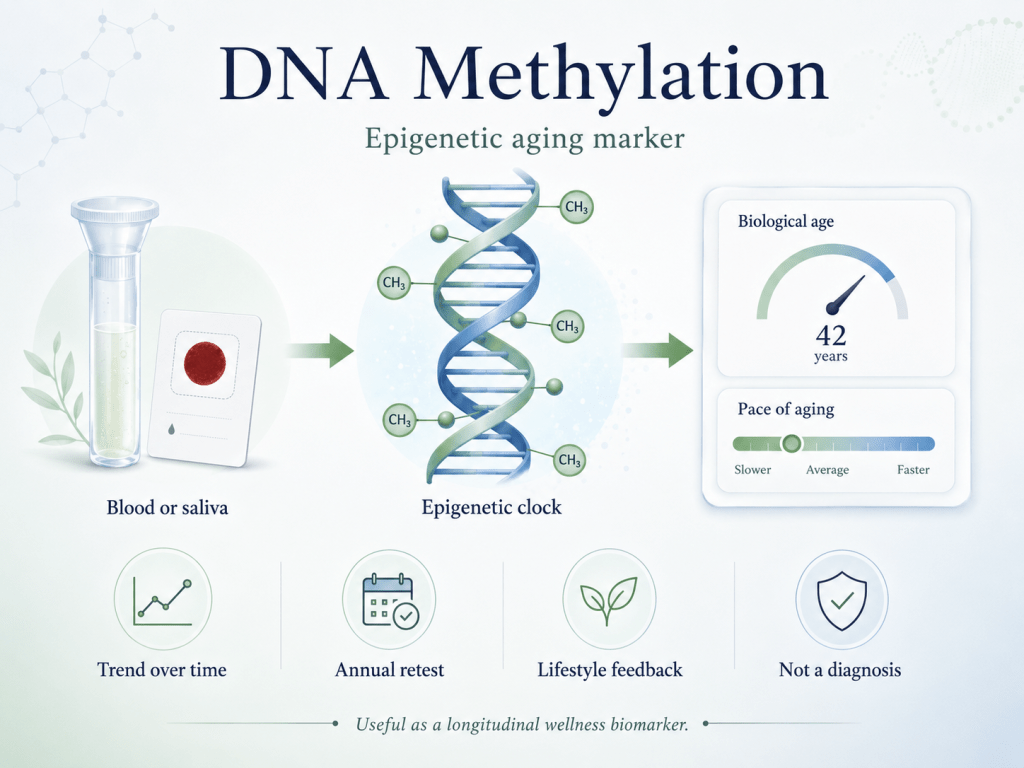
A DNA methylation test does not reveal a hidden expiry date encoded in your genome, and a result saying that your “biological age” is 45 when your chronological age is 50 does not demonstrate that you have added five years to your life expectancy. Epigenetic clocks are algorithms that use methylation at particular locations in DNA—usually CpG sites—to generate an age-related score, and different generations of clocks were developed for very different purposes. Some primarily predict chronological age, while newer clocks attempt to predict health outcomes, mortality risk or the pace at which ageing is occurring.
For us, the question is therefore not simply whether a DNA methylation test is scientifically sophisticated, because it clearly is, but rather whether a €129, €199 or $499 measurement produces enough actionable information to justify the expense—and, importantly, whether the same test is useful enough to buy again a year later.
Who is recommending DNA methylation tests?
Bryan Johnson is probably the most visible consumer advocate for this type of testing. His Blueprint program currently sells a $325 Speed of Aging test that uses an at-home blood sample, reports the pace of ageing and estimated ages of 11 organ systems, and explicitly recommends testing at least once each year.
Johnson has also used epigenetic measurements extensively within his own quantified-health program, helping push methylation testing from a specialist research tool into the mainstream longevity conversation. TruDiagnostic, one of the larger commercial epigenetic-testing laboratories, has also documented its use in Johnson’s age-tracking program.
Andrew Huberman’s platform has discussed biological-age and methylation measurements repeatedly, particularly in conversations with David Sinclair, Bryan Johnson and Peter Attia, but it would be misleading to describe this as a blanket recommendation that everyone should buy an epigenetic test. The emphasis has generally been on understanding ageing biology and interpreting new measurements rather than replacing established medical risk markers with biological-age scores.
Peter Attia is particularly useful as a counterweight to the enthusiasm. In 2023, he argued that he did not put much stock in available epigenetic-age clocks because a biomarker becomes clinically valuable only when we understand what it predicts and whether deliberately changing the biomarker corresponds to changing outcomes that actually matter. In April 2026, however, he devoted a detailed discussion to the newer generation of ageing clocks and their potential applications, reflecting how quickly the science is evolving while still emphasizing their limitations.
DNA methylation clocks are increasingly important research tools, some prominent longevity practitioners use them for longitudinal feedback, but they have not replaced clinically validated measures of cardiovascular, metabolic, neurological or cancer risk.
What is actually being measured?
DNA methylation is one of the mechanisms through which cells regulate gene activity without altering the underlying DNA sequence.
As humans age, methylation patterns at many locations change in reasonably predictable ways. Researchers discovered that combinations of these changes could be used to construct mathematical “clocks,” beginning with influential first-generation models such as the Horvath clock and progressing toward newer measures designed around health outcomes rather than calendar age.
Researchers followed participants in the long-running Dunedin Study and measured changes across multiple indicators of organ-system integrity over years. They then developed a blood DNA-methylation algorithm intended to estimate how quickly those biological changes are occurring. A score of approximately 1 represents roughly one biological year of ageing per chronological year, while a lower value indicates a slower measured pace.
This is potentially more useful for longevity experimentation because it attempts to answer: “How quickly am I currently ageing?”
rather than merely: “What age does my methylation pattern resemble?”
Even so, it remains a biomarker rather than a clinical endpoint.
Why this may be interesting for brain health
DunedinPACE is particularly interesting because population research has associated a faster measured pace of ageing with cognitive dysfunction, incident dementia and mortality.
Studies comparing three generations of methylation clocks have also examined associations with mild cognitive impairment, dementia and Alzheimer’s-related measures, suggesting that some newer clocks capture health-relevant information that first-generation chronological-age predictors do not.
Research has additionally found that slower DunedinPACE statistically explains part—but not all—of the association between healthier dietary patterns and lower dementia and mortality risk.
A result showing a faster pace of ageing should not be interpreted as a dementia diagnosis, and a favorable result should not provide reassurance that established neurological, cardiovascular or metabolic risk factors can be ignored.
The biggest limitation: the clocks are not interchangeable
One of the easiest mistakes is to treat “biological age” as though it were a standardized laboratory unit such as blood glucose.
Different clocks were trained on different populations, different biological endpoints and sometimes different tissue types. A first-generation chronological-age clock, a mortality-oriented clock such as GrimAge and a pace-of-ageing algorithm such as DunedinPACE are answering related but different questions.
Measurement noise matters as well. Research has shown that technical variation in methylation data can produce substantial differences in the output of some epigenetic clocks; one methodological study reported deviations of up to nine years between technical replicates for certain commonly used clocks and proposed computational methods to improve reliability.
This leads to one of the most important rules for using these products:
Do not compare a score from one company with a score from another company as though they were the same measurement.
If the purpose is to see whether your biological trajectory changes over time, use the same sample type, the same laboratory and the same algorithm whenever possible.
Minimum quality: what should you pay for?
The number of CpG sites measured is useful information, but it is not by itself a measure of test quality.
A carefully validated targeted assay can be useful while a huge dataset interpreted by a poor algorithm can be misleading. The minimum quality threshold should therefore include a combination of analytical quality and transparent interpretation.
Before paying for a methylation-age test, we would want to know five things.
First, what clock is actually being used? Ideally, the provider should identify a published algorithm such as DunedinPACE or clearly describe and validate its proprietary methodology. “AI biological age” without methodological detail is insufficient.
Second, is the clock appropriate for the sample? Blood and saliva contain different cellular mixtures. A methodology validated using blood should not automatically be assumed to behave identically when applied to saliva.
Third, how reproducible is the laboratory process? Laboratory accreditation, replicate measurements, published analytical validation and transparent quality-control procedures matter more than impressive marketing language. DunedinPACE itself was designed in part by selecting methylation probes with good test-retest reliability.
Fourth, will the methodology remain stable enough for retesting? A longitudinal test is only useful when today’s measurement can reasonably be compared with next year’s.
Fifth, what happens to your sample and data? Genetic and health-related information receives special protection under European data-protection law, and consumers should check retention, research consent, deletion policies and international data transfers before submitting a sample.
A laboratory certificate alone does not establish that a proprietary “organ age” algorithm is clinically validated.
It establishes laboratory quality, which is important—but it is a different question.
How should you use a methylation test?
The best model is to treat the first measurement as a baseline, not a verdict.
Take the test during a relatively normal period rather than during acute illness or immediately after an extreme change in diet, sleep or training. Some commercial providers themselves warn that temporary biological stressors such as recent illness can influence results.
Then continue measuring the things for which we already have much stronger clinical evidence: blood pressure, lipid and cardiovascular risk, glucose metabolism, body composition where relevant, cardiorespiratory fitness, sleep, exercise, smoking, alcohol exposure and appropriate medical screening.
The methylation result sits above that system as an experimental feedback tool.
For most healthy users, annual testing is a reasonable default. Blueprint explicitly recommends at least once-yearly measurement, while some commercial services propose six-to-twelve-month retesting.
A six-month retest can be interesting after a major and sustained intervention, but frequent testing is harder to justify because biological and analytical variability can easily be mistaken for meaningful rejuvenation.
And avoid one common biohacking mistake: changing ten variables simultaneously.
If sleep, exercise, diet, weight, alcohol, sauna, fasting and six supplements all change between test one and test two, an improved result may be encouraging but tells you almost nothing about which intervention mattered.
Regulation: the United States, Europe and Asia are different markets
United States
The American direct-to-consumer testing environment is comparatively permissive. FDA describes direct-to-consumer tests as in-vitro diagnostics sold without healthcare-provider involvement and explains that different tests follow different regulatory pathways. Some direct-to-consumer tests have received FDA marketing authorization.
FDA also updated its policy on low-risk general-wellness products in January 2026. A product positioned as a wellness measurement is therefore fundamentally different from an FDA-authorized diagnostic intended to establish or manage a disease.
Commercial availability does not mean that FDA has validated the claim that a biological-age score predicts your lifespan or proves that an intervention has reversed ageing.
European Union
European consumer products often explicitly describe themselves as wellness measurements rather than medical diagnostics. epiAge, for example, states that its test determines epigenetic age but is not a medical examination, diagnosis, treatment, preventive measure or disease-risk assessment.
Europe also provides an important privacy advantage: genetic and health-related information falls within specially protected categories of personal data under the GDPR.
That does not eliminate privacy risk, but it gives European consumers stronger statutory protections over how sensitive data is processed.
Switzerland
For Swiss consumers, we would particularly favor providers with established European logistics and clear sample-return procedures rather than simply ordering the most sophisticated-looking American kit.
Asia
Japan, for example, distinguishes testing performed with approved in-vitro diagnostic products under the PMD Act from laboratory-developed testing conducted within the medical system, with different responsibilities for quality and performance.
China, Singapore, South Korea and other jurisdictions have their own rules, particularly around genetic information and cross-border biological samples.
Four methylation tests accessible to European consumers
Prices below were checked on 8 August 2026 and should be reconfirmed before ordering.
| Product | Sample / methodology | Current price | Switzerland / Europe | Advantages | Limitations | Our viewview |
|---|---|---|---|---|---|---|
| Aeternum DNA Biological Age Test | Saliva; proprietary methylation analysis across hundreds of thousands of sites; company states CLIA-certified laboratory | €129 | European store; company states worldwide shipping | Lowest verified entry price; simple collection; broad methylation coverage; designed for 6–12 month tracking | Proprietary clock is less transparent than a named published algorithm; strong accuracy claims come primarily from the vendor | Budget option for someone mainly interested in a repeatable biological-age trend. |
| epiAge – Life Extension Europe | Saliva; exactly 13 selected CpG islands; Illumina NGS; each sample analysed three times | €199 | Explicitly ships to Switzerland and 30+ European countries | Very transparent assay description; repeat measurements; European logistics; provider states genetic sequence data is not collected | Narrower output than advanced pace-of-ageing tests; returns require postage; principally an epigenetic-age score | Preferred straightforward European option, particularly for Swiss consumers prioritizing simple logistics and transparency. |
| DoNotAge Biological Age Test Kit | DNA methylation-based biological-age test; broader longevity-oriented report | from $275 | Company operates European store and states worldwide shipping | Established European longevity supplier; accessible European distribution; broader health-oriented reporting | Public technical description of the precise clock is less transparent than DunedinPACE-based services; verify current contents before ordering | Mid-range alternative, especially for existing DoNotAge customers, but I would want more algorithm transparency before making it the preferred test. |
| TruDiagnostic TruAge | Finger-prick blood; OMICmAge, DunedinPACE, 11 organ-system scores and numerous methylation-derived measures | $499 | International testing is supported; non-US kits use international return arrangements, although exact Swiss costs should be confirmed before checkout | Strongest analytical depth here; named third-generation pace-of-ageing algorithm; blood sample; extensive published-science integration | Roughly 2.5× epiAge price; large number of inferred scores may create false precision; sophisticated output is not equivalent to diagnosis | Preferred advanced/research-oriented option when DunedinPACE and longitudinal depth justify the cost. |
Where does Blueprint fit?
Bryan Johnson’s Blueprint Speed of Aging test is a particularly interesting fifth benchmark.
At $325, it sits between the European mid-range tests and TruDiagnostic, uses an at-home blood sample, reports ageing speed and estimated ages for 11 organ systems, and recommends annual testing.
Scientifically and conceptually, this is closer to the type of test we find interesting than a simple “you are four years younger” score because the emphasis is on pace and longitudinal measurement.
What does this cost over time?
The first test is not really the relevant cost. A methylation clock becomes much more interesting when the same test is repeated.
At current list prices:
Aeternum: two tests ≈ €258
epiAge: two tests ≈ €398, plus applicable return postage
DoNotAge: two tests from approximately $550
Blueprint: two tests ≈ $650
TruDiagnostic TruAge: two full tests ≈ $998
The financial question is therefore not:
“Is €199 interesting enough for one biological-age number?”
It is:
“Would I pay roughly €400 to establish a baseline and obtain a comparable measurement one year later?”
That is a substantially better way to think about the purchase.
Where should DNA methylation sit in a longevity budget?
If someone has €200 available for preventive health but has never properly measured blood pressure, lipids, glucose, cardiovascular risk or other conventional risk factors, we would spend the money on established clinical measurements first.
If those fundamentals are already covered, fitness and sleep are being monitored, appropriate screening is up to date, and the objective is to add an experimental measure capable of capturing broader biological change, then DNA methylation becomes much more defensible.
This is particularly true for someone running a multi-year health project rather than looking for immediate reassurance.
And this is where the technology fits nicely with our broader value approach:
pay first for information that changes decisions; pay second for measurements that help improve the decisions; pay last for measurements that are merely interesting.
Value selection
For a Swiss or European consumer, our current hierarchy is relatively simple.
Best European starting point: epiAge — €199.
It has straightforward European and Swiss delivery, unusually clear methodology, a focused report, triple laboratory analysis and an explicit statement that it is an epigenetic-age measurement rather than a medical diagnosis.
Best budget experiment: Aeternum — €129.
The price is compelling and the European site states worldwide delivery, but the underlying proprietary algorithm is less transparent, so I would treat it primarily as a personal longitudinal score rather than as a benchmark to compare with other ageing clocks.
Best advanced option: TruDiagnostic TruAge — $499.
If the objective is serious self-tracking rather than curiosity, the inclusion of DunedinPACE makes the extra cost scientifically more interesting. TruDiagnostic’s current platform reports pace of ageing together with multiple system-level measurements, and its testing infrastructure is closely connected to the academic epigenetic-clock field.
Conclusion: a speedometer, not a crystal ball
DNA methylation clocks are probably among the more credible tools in the exploratory longevity market.
Unlike many fashionable wellness measurements, they grew out of a substantial academic literature, newer clocks correlate with important health outcomes, and research published in 2026 continues to strengthen the evidence that longitudinal changes in some epigenetic clocks contain information related to future health and survival.
But that does not mean we have discovered a laboratory test for remaining lifespan.
For that reason, the sensible approach is to establish one baseline, concentrate on interventions with established benefits, and repeat the same measurement after roughly six to twelve months—or simply annually—rather than chasing small fluctuations across competing clocks.
If the score improves, consider it encouraging evidence.
If it worsens, investigate the fundamentals.
In neither case should the number overrule conventional medicine.
The technology is getting better quickly.
The most valuable development over the next several years will not be another company claiming that it can tell us our “true age,” but stronger evidence that a change in a particular methylation measure reliably predicts a corresponding change in disease, disability, cognitive decline and ultimately healthy lifespan.
That is the point at which an interesting longevity measurement becomes a genuinely valuable health tool.
Selected bibliography
Horvath S. and subsequent epigenetic-clock research: DNA methylation clocks established methylation patterns as reproducible age-related biomarkers and provided the foundation for later health-oriented clocks.
Belsky D.W. et al. Quantification of the pace of biological aging in humans through a blood test, the DunedinPoAm DNA methylation algorithm. eLife, 2020.
Belsky D.W. et al. DunedinPACE, a DNA methylation biomarker of the pace of aging. eLife. The updated algorithm was trained using longitudinal decline in 19 measures of organ-system integrity and selected reliable methylation probes.
Sugden K. et al. Research associating DunedinPACE with cognitive dysfunction, incident dementia and mortality. Neurobiology of Aging, 2024.
Research comparing first-, second- and third-generation methylation clocks with cognitive impairment and Alzheimer’s-related outcomes.
2026 longitudinal research showing that change over time in several methylation clocks predicts long-term mortality, adding support to repeated rather than purely cross-sectional testing.
FDA: Direct-to-Consumer Tests and General Wellness guidance.
European Union: Regulation (EU) 2017/746 on in-vitro diagnostic medical devices.
Swiss Federal Office of Public Health: regulation and consumer guidance concerning genetic testing.
Editorial note: prices, availability and shipping conditions were reviewed on 8 August 2026. They should be checked again before publication or purchase. DNA methylation biological-age tests are not substitutes for medical diagnosis, evidence-based screening or professional medical advice.

