A blood test is a measurement system: a relatively inexpensive way of finding cardiovascular risk, metabolic dysfunction, deficiencies, organ abnormalities and changes over time that may justify doing something differently. In that sense, blood testing belongs alongside blood pressure, body composition, fitness and basic preventive medicine, rather than alongside speculative anti-ageing treatments.
The useful question is therefore : Which biomarkers are sufficiently reliable and actionable that knowing the result could change a decision?
That distinction matters because longevity testing has become a numbers game. One provider advertises 50 biomarkers, another 100 and another 160+. Yet the larger panel is not necessarily more useful. Some companies count every component of a complete blood count separately, others add calculated ratios and proprietary “scores,” while others include hormones, micronutrients and experimental biomarkers whose interpretation in healthy people is much less certain.
For example, Swiss provider Evidalife currently describes its CHF 199 Core test as 38 measured biomarkers producing 58 markers and scores, while its CHF 499 Pro package expands to 55 biomarkers and 85 reported markers and scores. In the United States, Function Health advertises more than 160 laboratory tests across its annual testing program. These are fundamentally different counting systems, so the headline number is a poor basis for comparison.
More data is not automatically more health information.
What should be in a longevity blood panel?
There is no universally accepted “longevity blood panel.” Peter Attia, Andrew Huberman and their guests have helped popularise a more aggressive approach to measuring cardiovascular and metabolic health, but their discussions should be understood as expert protocols and educational content rather than population-wide clinical guidelines.
Peter Attia places particularly heavy emphasis on Apolipoprotein B, or ApoB, because it approximates the number of atherogenic lipoprotein particles capable of entering the arterial wall. He also advocates knowing lipoprotein(a), or Lp(a), and pays considerable attention to glucose regulation and insulin resistance.
Importantly, part of this formerly “longevity medicine” territory is moving into mainstream cardiology. The 2026 American Heart Association/American College of Cardiology dyslipidaemia guideline recommends measuring Lp(a) at least once and gives ApoB an expanded role in risk assessment, particularly in people with diabetes, elevated triglycerides or discordant conventional cholesterol measurements.
Huberman Lab discussions similarly give substantial attention to ApoB, conventional lipids, fasting glucose, HbA1c and, depending on the context, fasting insulin, hsCRP, uric acid, GGT and hormone measurements. Huberman’s material also illustrates why a fixed “Huberman panel” is not particularly useful: hormones such as testosterone, estradiol, cortisol, IGF-1 and SHBG can be informative in the right clinical context but are not automatically essential longevity screening tests for every healthy adult.
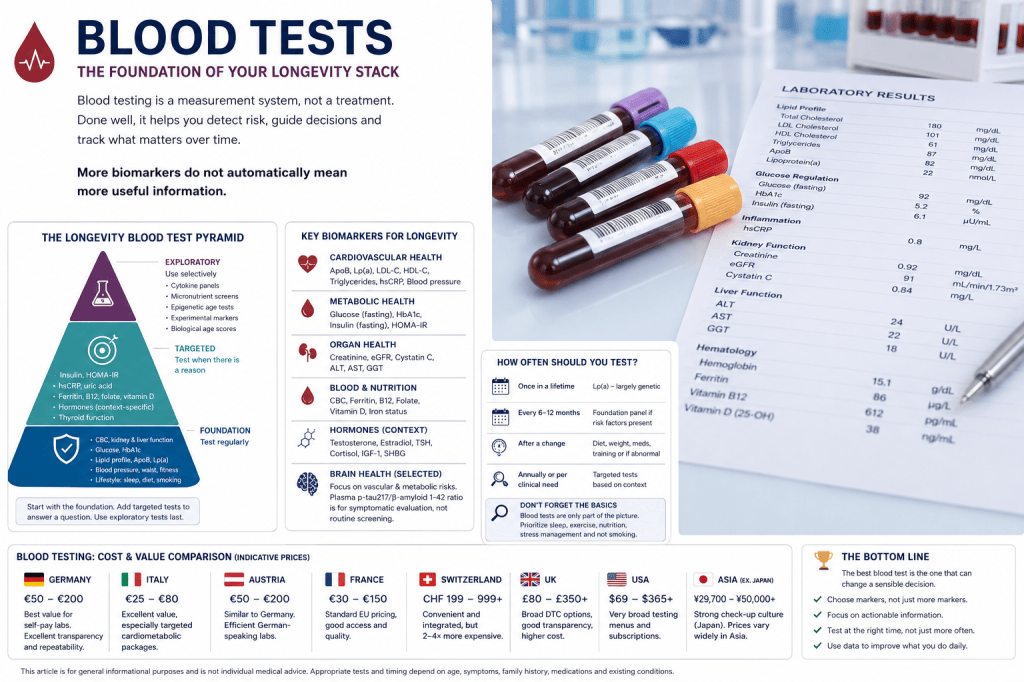
A practical value approach is to divide blood testing into three layers.
The foundation is relatively unglamorous: a complete blood count; kidney function such as creatinine and estimated GFR; liver markers; glucose and HbA1c; a conventional lipid profile; ApoB; and Lp(a), which generally needs to be established once rather than repeatedly measured in everyone. Depending on age, sex, diet, medical history and symptoms, thyroid function and iron status can also belong relatively close to this core.
HbA1c and fasting plasma glucose are established tools for detecting diabetes and pre-diabetes; an oral glucose tolerance test can add information in selected circumstances. By contrast, the 2026 American Diabetes Association standards do not regard continuous glucose monitoring as an established diagnostic screening method for people without diabetes.
The targeted layer can include fasting insulin or HOMA-IR, hsCRP, cystatin C, ferritin and transferrin saturation, B12, folate, vitamin D, uric acid and selected hormone testing. These can be very useful when there is a reason to look — a particular diet, medication, symptom, family history, athletic workload or abnormality elsewhere — but that is different from saying every person should pay to measure all of them every six months.
Then comes the exploratory layer: large cytokine panels, broad micronutrient screens, epigenetic-age tests, proprietary biological-age scores and other emerging measurements. Some are scientifically interesting. Few deserve priority over controlling blood pressure, ApoB, smoking, diabetes, exercise, sleep and excess adiposity.
A sensible consumer rule of thumb — not a clinical guideline — is that something like 20–40 reportable values can already cover a remarkably large part of the actionable blood-based risk picture. The precise number is meaningless without knowing what is being counted.
The problem with the 100-marker blood test
The more things we measure in healthy people, the more incidental abnormalities we create. That can lead to repeat testing, specialist referrals, anxiety and occasionally unnecessary investigations. Laboratory medicine has long recognised that mildly abnormal results in otherwise well people can be clinically irrelevant and that indiscriminate testing creates downstream costs as well as information.
Morevoer, exercise, recent illness, hydration, fasting status and time of day can materially change some measurements. Hormones can be especially difficult to interpret from a single sample. Reference ranges also describe populations; they are not necessarily equivalent to an individual’s treatment target. Cardiovascular targets, for example, should depend on total risk rather than whether LDL or ApoB happens to carry a reassuring “green” flag on a laboratory application.
And trends should not be confused with diagnoses. Repeating the same well-chosen measurements under reasonably comparable conditions can be far more useful than collecting a new set of exotic biomarkers every year.
What about blood biomarkers for brain health?
The most useful blood-based brain-health strategy today may actually be surprisingly conventional.
Vascular and metabolic health are intimately linked to long-term cognitive risk. The World Health Organization’s updated 2026 dementia-risk guidance puts hypertension, diabetes and high cholesterol among the modifiable factors that should be addressed, while the 2024 Lancet Commission also identified high LDL cholesterol in midlife as a modifiable dementia risk factor. In practical terms, ApoB/LDL, glucose regulation and the broader cardiovascular risk profile may currently be more actionable brain-health measurements for an asymptomatic middle-aged person than an expensive “neuro-longevity” blood panel.
There is nevertheless an important scientific development taking place in Alzheimer’s disease. In 2025 the US FDA cleared the first blood test using a plasma p-tau217/beta-amyloid 1-42 ratio to aid the evaluation of Alzheimer’s pathology. But this is not a general longevity-screening test: the FDA indication concerns people aged 55 and older who already show signs and symptoms of cognitive decline, and the result is intended to be interpreted alongside other clinical information. The Alzheimer’s Association’s 2025 guideline similarly addresses blood biomarkers such as phosphorylated tau and amyloid ratios in people with objective cognitive impairment being evaluated in specialist memory-care settings, rather than screening healthy adults.
Other markers such as neurofilament light chain and GFAP are scientifically promising, but for the ordinary longevity consumer they still belong closer to specialist or exploratory testing than to the annual foundation panel.
United States versus Europe versus Asia
The global market is developing in noticeably different directions.
| Market | Typical model and current examples | What it does well | Main limitation | Guidefinances view |
|---|---|---|---|---|
| United States | Very broad direct-to-consumer testing. Function Health advertises 160+ annual tests and currently markets membership at $365/year; Labcorp OnDemand lists ApoB at $69 and Lp(a) at $49. | Convenience, consumer access, dashboards and longitudinal testing | Easy to overscreen; interpretation and medical follow-up vary; DTC regulatory status depends on the test. | Best market for breadth, not necessarily for disciplined testing |
| Japan | Strong integrated ningen dock health-check culture. Hino Municipal Hospital lists a Ningen Dock at ¥29,700; another hospital lists a half-day program at ¥49,500. | Efficient one-stop preventive examination combining laboratory tests with physical examination and often imaging | Advanced ApoB/Lp(a)-style longevity markers are not necessarily central to standard packages; language/logistics can raise costs for visitors. | Excellent check-up infrastructure; more integrated screening than “biomarker optimisation” |
| China | Large spectrum from domestic care to premium international hospitals. Beijing United Family currently lists basic health checks around RMB 1,650 and comprehensive packages approaching RMB 10,000–15,000. | Very comprehensive one-stop programs can be available | International private medicine is not automatically cheap; local pricing and packages are harder for foreign patients to compare | Potential value locally, but weak case for travelling from Europe solely for blood work |
| Thailand / medical-tourism Asia | Bangkok Hospital’s 2026 packages span roughly THB 5,500–35,000 depending on age and scope. | Broad preventive packages, good international-patient infrastructure | Travel cost and fragmented longitudinal follow-up can erase the laboratory saving | Attractive when already in the region; rarely worth a dedicated blood-test trip |
| Singapore | Public and private comprehensive screening is readily available, but published package costs extend from a few hundred Singapore dollars to considerably more. | High-quality healthcare environment and convenience | Not Asia’s budget option | Quality play rather than arbitrage |
| EU / Central Europe | Strong conventional laboratory networks; Germany in particular allows relatively inexpensive self-pay, à-la-carte testing | Low individual assay prices, easy repeatability, established medical infrastructure | Less slick than US longevity subscriptions; interpretation may need to be organised separately | Probably the best combination of price, repeatability and clinical usefulness for Central-European readers |
| Switzerland | Growing premium preventive platforms; Evidalife currently lists CHF 199 Core and CHF 499 Pro blood packages. | Convenience, Swiss laboratories, integrated reporting and support | Considerably higher spend once comprehensive add-ons are included | Rational premium for convenience; weak choice if price per actionable marker is the objective |
There is no single “Asian model.” Japan’s mature health-check culture, China’s enormous public/private divide, Singapore’s high-cost healthcare market and Thailand’s medical-tourism industry should not be collapsed into one comparison.
Europe has a different advantage: it is unusually easy to assemble a reasonably sophisticated panel from conventional accredited laboratories without buying an entire longevity program. EU in-vitro diagnostic regulation has also moved under the IVDR framework since 2022, while Switzerland operates its own closely related IVD framework.
Where is the best value in Central Europe?
For a reader based around Switzerland, southern Germany, Austria or northern Italy, geography changes the economics considerably.
The original temptation is to compare one “full check-up” price between countries. That can be misleading because a €50 basic panel and a CHF 500 longevity panel may contain entirely different measurements.
The better comparison is what it costs to build a repeatable, actionable panel.
| Location / example | Current pricing signal | What stands out | Limitation | Our view |
|---|---|---|---|---|
| Germany — Berlin / Stuttgart / Freiburg | Mein Direktlabor’s current self-pay lists show, for example, ApoB around €13.41, Lp(a) €20.11, HbA1c €13.41 and hsCRP €13.41; many routine chemistry tests cost only a few euros each. Its network includes Berlin, the Stuttgart region and Freiburg. | Excellent à-la-carte economics and transparency | A genuinely broad panel with omega-3 index, homocysteine and numerous extras can still exceed €200 | Best repeat-testing value for many Central-European self-pay patients |
| Northern Italy — Verona example | Ospedale Sacro Cuore currently lists a €25 “Diabetes and Lipid Metabolism” package including ApoA1, ApoB, Lp(a), HbA1c, glucose, insulin, triglycerides and conventional cholesterol measurements. | Exceptional cardiometabolic value | It is a targeted package, not a complete longevity examination | Outstanding opportunistic buy if nearby or already travelling in northern Italy |
| Austria — Vienna example | IHR LABOR currently lists ApoB at €19 on its private tariff. | Straightforward German-speaking laboratory access | A comparably transparent all-in longevity package was harder to verify | Sensible local alternative, but Germany has the clearer value proposition |
| France | Laboratory pricing is more regulated; one current BIO-CITY example offers a basic no-prescription prevention panel around €43–51 depending on package. | Cheap conventional testing and strong local access | Advanced longevity-marker pricing is less consistently packaged and advertised nationally | Good if already in France; little reason to travel there purely for testing |
| Switzerland | Evidalife: CHF 199 Core; CHF 499 Pro; CHF 999 Complete including additional longevity testing. | Integration, dashboard, partner laboratories and interpretation | Large premium versus purchasing individual conventional assays across the border | Pay the premium for convenience, not because Swiss blood is more informative |
| UK | PrivateTests lists a 46-biomarker Complete Longevity panel at £335; TrueVitals advertises 115 biomarkers at £349 plus collection from £19. | Excellent consumer-facing transparency and broad DTC choice | Cost plus travel makes little sense for most continental Europeans | Good domestic service, poor arbitrage destination |
Germany remains the Central-European value benchmark
For someone living around Stuttgart or Berlin, Germany is the obvious place to start because there is little reason to buy a bundled longevity subscription when many of the clinically useful measurements can be ordered individually at published self-pay tariffs.
The same logic becomes even stronger for readers around the Swiss border. For somebody closer to Weil am Rhein or Rheinfelden, Freiburg is one verified German direct-laboratory option within the broader regional network. Readers around Konstanz also benefit from being able to remain on the German side rather than automatically paying Swiss private-health pricing, although individual local providers and collection arrangements should be compared before travelling.
The qualification is important: a genuinely broad German “longevity” basket is no longer necessarily a €50 exercise. Once omega-3 index, homocysteine, vitamin D, cystatin C and other specialised measurements are added, the total can move comfortably past €200. Germany’s advantage is instead that the core assays are inexpensive enough that the consumer can leave out the low-value extras.
Northern Italy produces an interesting alternative. The €25 Verona cardiometabolic package is unusually aggressive pricing because it already includes ApoB, Lp(a), HbA1c and insulin in addition to the conventional lipid profile. It is not a complete health screen, but for somebody already travelling through northern Italy it is arguably one of the most compelling verified European bargains in this comparison.
How often should we test?
A provider that sells testing twice a year naturally has an incentive to make twice-yearly testing feel necessary. But biological usefulness should determine frequency, not the membership model.
Some measurements can reasonably be established once or only occasionally. Lp(a) is largely genetically determined, and the 2026 US cardiovascular guideline explicitly moves toward at-least-once lifetime measurement rather than treating it as an ordinary quarterly tracking metric.
Other markers make sense to repeat after a meaningful intervention: a substantial dietary change, weight loss, initiation or modification of medication, correction of a deficiency, or treatment of a previously identified risk factor. People with established disease or medication monitoring needs follow a different schedule from healthy consumers buying preventive tests.
The objective is to create a longitudinal record slowly enough that the measurements correspond to meaningful biological or behavioural changes.
Testing simply because another six months have elapsed can become data collection without decision-making.
Our value longevity blood-test hierarchy
For most healthy adults interested in longevity, blood testing belongs in the Foundation tier — but only the disciplined version of it.
The foundation is conventional cardiometabolic and organ-health testing, with ApoB and a one-time Lp(a) increasingly difficult to dismiss as merely “advanced” longevity markers given current cardiovascular guidance. HbA1c and glucose belong here too, while blood pressure, waist circumference, exercise capacity and smoking status remain crucial even though no laboratory can put them in a test tube.
The Targeted tier begins when testing responds to a question: insulin resistance, anaemia, thyroid dysfunction, vitamin deficiency, renal risk, inflammation, hormone symptoms or a particular medication.
The Exploratory tier is where many of the expensive longevity packages earn their impressive marker counts: biological-age scores, broad inflammatory panels, emerging neurological biomarkers and measurements for which neither an abnormal result nor its treatment pathway is yet particularly clear.
That does not make exploratory testing illegitimate. Curious people may rationally spend money on it, just as they might spend money on a high-end wearable.
But it should come after the boring things.
Value conclusion
Blood testing is one of the strongest measurement layers in a sensible longevity stack, but the value comes from selecting markers, not accumulating them.
Attia and Huberman have helped draw useful attention to ApoB, Lp(a), glucose regulation and other measurements that conventional check-ups sometimes underuse. The encouraging development is that some of these ideas — especially Lp(a) and ApoB — are increasingly reflected in mainstream cardiovascular guidance rather than remaining the territory of longevity enthusiasts.
The mistake is to extrapolate from “some additional biomarkers are useful” to “160 biomarkers must be better than 30.”
For a value-conscious Central-European consumer, Germany currently offers the strongest combination of low assay prices, transparent self-pay access and repeatability. Northern Italy can be even cheaper for selected packages and is worth exploiting when the geography makes sense. Switzerland is more expensive but can justify its premium through integration, interpretation and convenience. The UK offers polished consumer testing but little economic reason for a continental European to travel there.
The US remains the most developed market for large-scale consumer biomarker subscriptions, while Japan offers perhaps the most mature integrated check-up culture. China and medical-tourism destinations in Asia can provide comprehensive examinations, but travelling thousands of kilometres to save on a blood draw is usually poor longevity economics: continuity and comparable repeat measurements matter more than obtaining the world’s cheapest isolated panel.
And brain biomarkers deserve particular restraint. Plasma Alzheimer’s biomarkers such as p-tau217 are becoming genuinely clinically useful — an important advance — but that does not turn them into routine screening tests for neurologically healthy longevity consumers.
The best blood test is ultimately the one that can change a sensible decision.
Pay first for actionable information, second for convenient interpretation, and only then for interesting data. The 100th biomarker nobody knows what to do with may be considerably more expensive than its laboratory price suggests.
This article is for general informational purposes and is not individual medical advice. Appropriate tests and testing frequency depend on age, symptoms, family history, medications, pregnancy status and existing medical conditions; abnormal or unexpected results should be interpreted with a qualified clinician.
Selected sources
- 2026 AHA/ACC Guideline on the Management of Dyslipidemia — current guidance on ApoB and Lp(a).
- American Diabetes Association, Standards of Care in Diabetes 2026 — glucose and HbA1c screening and diagnostic guidance.
- World Health Organization, 2026 dementia risk-reduction guideline, and the 2024 Lancet Commission on dementia prevention.
- US FDA and Alzheimer’s Association — current clinical status of Alzheimer’s blood biomarkers.
- Peter Attia MD and Huberman Lab materials — examples of expert longevity approaches to ApoB, metabolic health and blood testing; used as expert context rather than clinical evidence.
- Current provider price schedules: Mein Direktlabor/Bioscientia, Ospedale Sacro Cuore, Evidalife, PrivateTests, TrueVitals, Labcorp and Function Health.
- Current Asian check-up examples from Hino Municipal Hospital, Fujisawa Tokushukai Hospital, Beijing United Family Hospital and Bangkok Hospital.
Prices, package contents, availability and regulatory information were reviewed on 9 August 2026. Laboratory tariffs and promotional packages can change and should be checked again before booking.

