Fasting occupies an unusual position in longevity medicine. The biological rationale is interesting, the metabolic effects are measurable, but prolonged water-only fasting is difficult to tolerate and can become medically problematic surprisingly quickly in the wrong person.
The Fasting Mimicking Diet (FMD), or Dieta Mima Digiuno™, was designed to find a middle ground: eat a carefully restricted amount of food for several days while reproducing some of the metabolic characteristics of fasting.
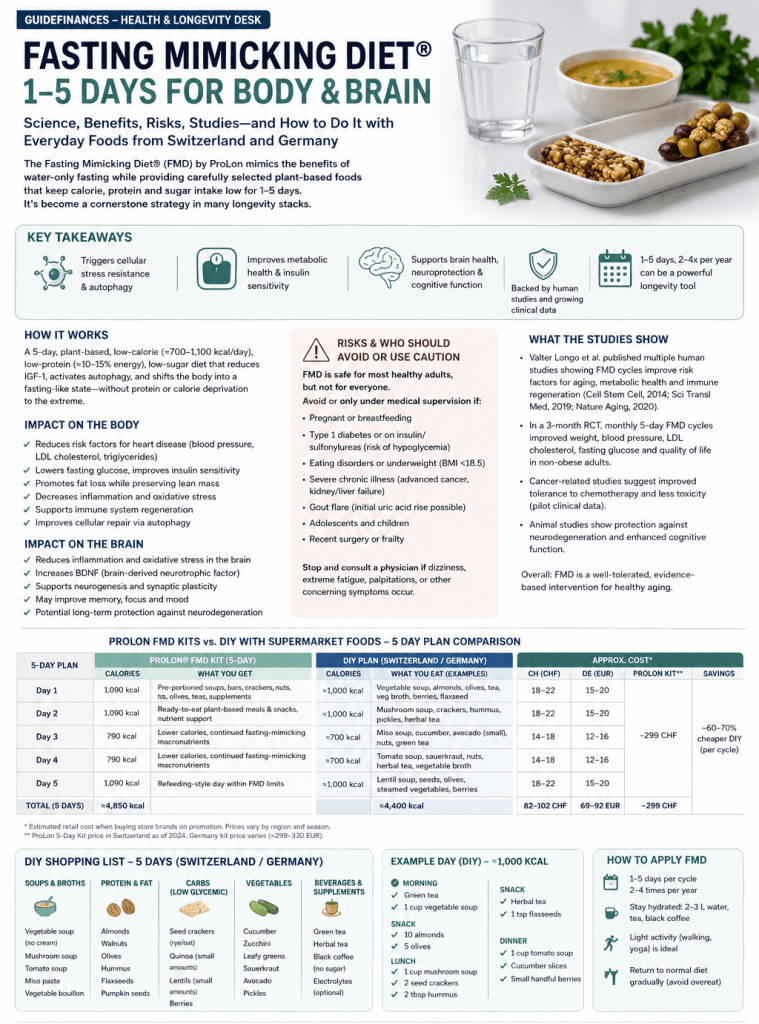
The best-known commercial implementation is ProLon, based on research associated with Valter Longo and colleagues. The current five-day ProLon kit is listed at CHF 199. It contains portioned soups, nut-based bars, crackers, olives, herbal teas, an energy drink and nutritional supplements.
What does a Fasting Mimicking Diet actually do?
The human FMD used in published research is predominantly plant-based, deliberately low in calories and protein, relatively rich in unsaturated fat, and low enough in energy intake to push metabolism toward some of the conditions observed during fasting.
One widely studied formulation supplies approximately 1,100 kcal on day 1 and roughly 700–750 kcal on days 2–5. Protein provides only around 9–11% of energy. Fat contributes roughly 44–56%, with the remainder predominantly coming from carbohydrates.
The objective is not simply calorie restriction. The combination of reduced calories, low protein and relatively high unsaturated fat is intended to influence glucose, insulin, ketone production and the IGF-1 pathway.
That is why eating 750 kcal of chicken breast and protein shakes is not a Fasting Mimicking Diet.
What has actually been demonstrated in humans?
The human evidence is interesting, but considerably narrower than some longevity marketing suggests.
A randomized trial involving 100 generally healthy adults studied three monthly five-day FMD cycles. Compared with the control period, FMD reduced body weight, trunk and total body fat, blood pressure and IGF-1. In post-hoc analyses, participants starting with less favourable metabolic risk factors also showed larger improvements in markers including glucose, triglycerides, LDL cholesterol and CRP. No serious adverse effects were reported in that study.
A 2024 analysis of FMD clinical-trial data found reductions in insulin resistance and liver fat and changes in immune-cell profiles after three cycles. It also reported an approximately 2.5-year reduction in median calculated biological age. That is worth investigating, but it should not be translated into “the participants became 2.5 years younger.” Biological-age algorithms are surrogate biomarkers, not measurements of extra lifespan.
What does fasting do to the brain?
In animal experiments, FMD cycles have been associated with increased markers of hippocampal neurogenesis and improved cognitive performance. In Alzheimer’s disease mouse models, periodic FMD reduced amyloid-beta burden, phosphorylated tau and neuroinflammatory signalling while improving cognitive performance.
Human research into fasting and cognition more broadly remains heterogeneous. A systematic review of randomized trials found insufficient evidence for confident claims that intermittent fasting improves cognition in healthy adults.
Metabolic health may indirectly support brain health, while direct claims about neurogenesis, dementia prevention or cognitive rejuvenation remain exploratory in humans.
Why use FMD instead of a water-only fast?
Complete prolonged fasting places a greater physiological burden on the body.
An FMD still reduces glucose intake, energy availability and anabolic signalling substantially, but provides some carbohydrate, fat, micronutrients, fluid and food volume. That can make it easier to complete and may reduce some of the stresses associated with complete food deprivation.
But “easier than water fasting” does not mean “safe for everyone.”
ProLon’s own Swiss instructions state that its hypocaloric program was developed for healthy adults and should not be undertaken during pregnancy or breastfeeding, with an eating disorder, acute infection, malnutrition or significant underweight. It advises medical supervision for people with diagnosed conditions including type 1 or type 2 diabetes, cardiovascular disease, cancer, kidney disease, liver disease or a history of unconsciousness, and also for people below 20 or above 70 years of age. The company additionally advises avoiding high-calorie exercise and extreme heat such as saunas during the program.
Do not alter prescription medication yourself to accommodate a fast.
Should you do one, three or five days?
The evidence is not equally strong for every duration.
| Duration | What it represents | Guidefinances view |
|---|---|---|
| 1 day | A low-calorie plant-based fasting day | Useful for testing tolerance, but cannot inherit the five-day FMD evidence |
| 2 days | Day 1 followed by one low-calorie day | Practical adaptation, not a validated ProLon substitute |
| 3 days | Day 1 plus two lower-calorie days | Reasonable shortened experiment for healthy adults, but evidence remains extrapolated |
| 4 days | Closer to some early experimental/animal protocols | Still not identical to the main human five-day protocol |
| 5 days | Standard human FMD format | Closest to the clinical evidence |
ProLon itself currently also markets a one-day ReSet product, listed in Switzerland at CHF 55, but the existence of a one-day commercial product should not be interpreted as evidence that one day produces the same biological effects demonstrated in five-day studies.
What is actually inside a five-day ProLon program?
The official Swiss ProLon diet card says each day’s foods should remain within that day, although their order can be changed. The traditional Swiss kit allocates combinations of:
- nut-based L-Bar;
- Choco Crisp bar;
- tomato soup;
- mushroom soup;
- vegetable/minestrone soup;
- minestrone with quinoa;
- kale crackers;
- green olives with sea salt;
- green olives with garlic;
- spearmint tea;
- lemon-spearmint tea;
- hibiscus tea;
- L-Drink;
- NR-3 vitamin/mineral capsules;
- algal DHA oil.
The L-Drink is not ordinary flavoured water: the official formulation uses vegetable glycerol, and the amount is adjusted according to body weight. The official nutrition document says it is formulated to provide about 50 kcal for each 45 kg of body weight.
The NR-3 capsules contain a mixture of vitamins, minerals, cystine, methionine and other components, while the algal-oil capsule supplies DHA.
These three items are where the idea of an “exact supermarket clone” breaks down.
ProLon product by product: what can you buy instead?
1. Nut-based L-Bar
ProLon: Nut-based bar built largely around almonds/macadamia, pecans, coconut, flaxseed and related ingredients. The nutrition document lists the traditional 46 g bar at around 252 kcal.
DIY substitute: approximately 35–40 g total of natural almonds plus walnuts or macadamias, with a small amount of unsweetened coconut. If desired, approximately one teaspoon of honey can make the mixture closer to the commercial bar.
Do not use: conventional high-protein fitness bars. Their protein content works against the low-protein design of the FMD.
2. Choco Crisp
ProLon: a small cocoa/almond/inulin/oat/brown-rice-based bar; the traditional portion is around 23 g and roughly 96 kcal.
DIY substitute: approximately 10–12 g dark chocolate plus a small piece of plain rice cake or a little puffed rice.
The objective here is a small carbohydrate/fat snack, not a full chocolate bar.
3. Tomato soup
ProLon: dried tomato-based preparation containing rice flour, vegetables, herbs and some olive oil.
DIY substitute: 250–300 ml tomato and vegetable soup, ideally without cream and without a large amount of legumes or protein.
A simple homemade version using tomato, onion, carrot, herbs and approximately one teaspoon of olive oil is preferable to many cream soups.
4. Mushroom soup
ProLon: rice-based mushroom soup containing mushrooms, carrot, onion, inulin, olive oil and herbs.
DIY substitute: mushroom, onion and vegetable-stock soup with a little rice and olive oil.
Avoid cream-heavy mushroom soups if the aim is to stay closer to the plant-based FMD formulation.
5. Minestrone / vegetable soup
ProLon: vegetable mixture built around vegetables, rice ingredients, herbs and olive oil.
DIY substitute: frozen minestrone vegetables simmered in water or low-salt vegetable broth with a small amount of rice and olive oil.
Coop currently sells a 450 g frozen Orogel Minestrone vegetable mix for CHF 4.60 containing potatoes, carrots, tomatoes, beans, courgettes, cabbage, celery, peas, pumpkin, spinach, leek and herbs.
This is actually one of the easiest ProLon components to reproduce cheaply.
6. Minestrone with quinoa
ProLon: quinoa plus rice flour, potato, peas, cabbage, carrots, onions, courgette, tomatoes, inulin, celery, herbs and olive oil.
DIY substitute: vegetable minestrone plus a small quantity of quinoa, perhaps 10–15 g dry weight per serving rather than an ordinary bowl of quinoa.
The small portion matters because this is still an energy-restricted intervention.
7. Kale crackers
ProLon: traditionally based on almonds, sesame, tapioca, chia, flaxseed, kale and seasonings rather than conventional wheat crackers.
DIY substitute: approximately 15–20 g of a seed- or quinoa-based cracker.
This is a good example of why DIY should be called an approximation.
8. Green olives with sea salt
ProLon: approximately 20 g green olives with olive oil, sea salt and lactic acid in the traditional kit.
DIY substitute: 20–25 g plain green olives.
This is almost a direct supermarket swap.
9. Garlic olives
ProLon: green olives plus olive oil, sea salt, lactic acid, garlic and thyme.
DIY substitute: 20–25 g garlic-marinated green olives.
10. Spearmint / peppermint tea
ProLon: unsweetened mint infusion.
DIY substitute: ordinary peppermint or spearmint herbal tea.
There is essentially no rational reason to pay a premium for this component.
11. Lemon-spearmint tea
ProLon: spearmint, lemon peel and lemon myrtle.
DIY substitute: mint tea with a strip of fresh lemon peel or a caffeine-free mint/lemon infusion.
Do not add sugar or honey during the low-calorie days.
12. Hibiscus tea
ProLon: hibiscus-leaf infusion.
DIY substitute: any unsweetened hibiscus herbal tea.
Again, there is little value in trying to reproduce the branded product exactly.
13. L-Drink
ProLon: water plus vegetable glycerol and flavouring, diluted according to body weight and consumed across days 2–5.
DIY supermarket equivalent: none.
It is not recommended buying food-grade glycerol and reverse-engineering ProLon’s weight-based drink.
For a supermarket DIY version, drink water and unsweetened herbal tea instead.
If keeping total energy intake close to the research protocol, compensate for the missing L-Drink calories by slightly increasing olive oil, olives or nuts within the day’s planned energy intake.
This changes the macronutrient composition and therefore does not reproduce ProLon exactly.
14. NR-3 capsules
ProLon: a proprietary supplement containing selected vitamins, minerals, amino acids and related ingredients.
DIY supermarket equivalent: none.
Do not attempt to reproduce this with a collection of high-dose supplements.
Five days without the proprietary supplement makes the DIY diet scientifically different from ProLon, but improvising a supplement stack introduces additional risk without evidence that it improves the DIY protocol.
15. Algal DHA oil
ProLon: algal DHA supplement taken on selected days.
DIY supermarket equivalent: none.
Algal DHA supplements are widely available from pharmacies and supplement retailers, but they are not necessary to create the basic food pattern described here.
If someone already uses DHA, use the normal labelled or clinician-directed amount rather than inventing an FMD-specific dose.
A practical DIY five-day plan
This version deliberately follows the structure of the classic ProLon day boxes rather than merely inventing a five-day low-calorie diet.
Day 1 — higher-calorie entry day
Aim roughly toward the 1,000–1,100 kcal region used in FMD research.
Morning
Mint-lemon herbal tea.
35–40 g natural almond/walnut/macadamia mixture with a little coconut.
Lunch
250–300 ml tomato soup.
20–25 g green olives.
15–20 g quinoa/seed crackers.
Afternoon
Peppermint tea.
A second small 35–40 g nut portion.
Dinner
Large bowl of vegetable minestrone containing a modest quantity of rice or potato.
Approximately one tablespoon of extra-virgin olive oil distributed between the soups.
10–12 g dark chocolate plus a small piece of plain rice cake as the Choco Crisp approximation.
Plenty of water.
This is the closest DIY equivalent to ProLon’s more generous first day.
Day 2
Aim toward roughly 700–800 kcal.
Morning
Mint-lemon tea.
35–40 g nut mixture.
Lunch
Mushroom and vegetable soup.
20–25 g green olives.
Snack
20–25 g garlic olives.
Hibiscus or peppermint tea.
Dinner
Vegetable minestrone with approximately 10–15 g dry quinoa.
Small dark-chocolate/rice-crisp snack.
Water and herbal tea throughout the day.
Because the DIY plan contains no glycerol L-Drink, add a modest amount of olive oil to the soups if needed to keep total energy reasonably close to the intended range.
Day 3
Morning
Mint-lemon tea.
35–40 g nut mixture.
Lunch
Tomato soup.
15–20 g seed or quinoa crackers.
Dinner
Vegetable minestrone.
Use olive oil to provide most of the additional calories rather than adding protein.
Water, peppermint and hibiscus tea freely.
This is naturally one of the leaner days.
Day 4
Repeat the basic Day-2 pattern:
Nut mixture.
Vegetable soup.
20–25 g salted olives.
20–25 g garlic olives.
Small minestrone-quinoa dinner.
Small chocolate/rice-crisp snack.
Herbal teas and water.
Day 5
Repeat the basic Day-3 pattern:
Nut mixture.
Tomato soup.
Small cracker serving.
Vegetable minestrone.
Herbal tea and water.
The objective is not to make the final day progressively more restrictive. It is to complete the planned period without turning it into an uncontrolled water fast.
The three-day version
For someone choosing the shorter experiment:
Day 1: follow the higher-energy Day-1 pattern.
Day 2: follow the Day-2 pattern.
Day 3: follow the Day-3 pattern.
Then stop.
A three-day diet may generate fasting-like metabolic changes, but it should not be described as equivalent to the five-day intervention used in the principal human FMD trials.
ProLon vs DIY: the economics
| ProLon Switzerland | DIY Switzerland | DIY Germany | |
|---|---|---|---|
| Five-day program | CHF 199 | ~CHF 25–40 | ~€20–35 indicative |
| Food portioning | Exact | DIY | DIY |
| Published FMD formulation | Yes | No | No |
| L-Drink | Included | No true substitute | No true substitute |
| NR-3 supplement | Included | Not reproduced | Not reproduced |
| Algal DHA | Included | Optional external purchase | Optional external purchase |
| Shopping/preparation | Almost none | Required | Required |
| Portion-control discipline | High | User-dependent | User-dependent |
| Scientific equivalence | Reference commercial protocol | No | No |
The DIY figure is an indicative assembled basket, not a retailer package: current prices for nuts, tea, olives, vegetables, crackers and olive oil imply that approximately CHF 25–40 is enough to purchase the core foods, especially because significant amounts of tea, olive oil and some pantry products remain after the five days.
At the current CHF 199 ProLon list price, the commercial premium is therefore substantial.
But the comparison is not CHF 199 versus CHF 30 for exactly the same product.
It is approximately CHF 199 for standardisation, portion control, proprietary formulation and convenience versus perhaps CHF 30 for a nutritionally similar but scientifically unvalidated grocery experiment.
What happens after Day 5?
Do not celebrate the end of a five-day restriction with an enormous restaurant meal.
The traditional ProLon instructions designate Day 6 as a transition day, beginning with softer foods such as soups and vegetables before moving toward modest portions of rice, pasta, pulses and other normal foods.
A practical transition would be:
Breakfast or lunch: vegetable soup, fruit and/or cooked vegetables.
Later: rice, potato or a modest serving of legumes.
Dinner: return toward a normal Mediterranean-style meal rather than binge eating.
Then return to a normal high-quality diet.
FMD is not intended to become the diet eaten every day.
How often?
This is where longevity enthusiasm can turn a periodic intervention into unnecessary chronic restriction.
ProLon’s Swiss guidance states that a healthy person may ideally undertake the program around one to four times per year, and that a hypocaloric program should not be performed more than once per month without medical supervision.
Clinical studies have sometimes used monthly cycles because that frequency was part of the research question — including three consecutive monthly cycles in healthy adults and twelve cycles under medical supervision in people with type 2 diabetes.
That does not mean a metabolically healthy consumer requires twelve FMD cycles each year.
For longevity, more intervention is not automatically more benefit.
Value conclusion
The Fasting Mimicking Diet is one of the more scientifically credible ideas in the commercial longevity market, but this needs careful qualification.
There is meaningful human evidence for improvements in several cardiometabolic risk factors. There is early human evidence involving insulin resistance, liver fat, autophagy-related biomarkers and biological-age algorithms. There is supervised clinical evidence in selected patients with type 2 diabetes.
What we do not have is proof that FMD extends human life, regenerates the human brain or prevents Alzheimer’s disease.
The brain story remains particularly easy to oversell because some of the most impressive findings — increased hippocampal neurogenesis, reduced amyloid, reduced tau and improved cognition — come from mice rather than healthy human volunteers.
Do not try to reverse-engineer every element. In particular, there is little justification for DIY dosing of glycerol to reproduce the L-Drink or building your own NR-3 supplement stack.
Selected sources
Wei et al., Science Translational Medicine (2017): randomized human trial of three monthly FMD cycles and cardiometabolic risk factors.
Brandhorst et al., Nature Communications (2024): insulin resistance, liver fat, immune markers and biological-age analysis.
Human FMD autophagy pilot trial (2025): autophagic flux and metabolic biomarkers.
van den Burg et al., Diabetologia (2024): 12-month randomized FMD program in type 2 diabetes under primary-care supervision.
Rangan et al., Cell Reports (2022): FMD, Alzheimer’s models, neuroinflammation and small human feasibility component.
Prices, retailer availability, ProLon information and scientific literature were reviewed on 11 August 2026. Supermarket promotions and product availability can vary by branch and should be checked before shopping.
ProLon Switzerland: current five-day product, official meal program, nutritional information and medical precautions.
American Diabetes Association Standards of Care 2026: fasting and SGLT2-inhibitor ketoacidosis considerations.
Medical note: This article is general information and is not an individualized fasting prescription. Multi-day severe calorie restriction can be unsafe in pregnancy or breastfeeding, eating disorders, malnutrition/underweight, acute illness and numerous medical conditions. Anyone taking medication that can be affected by substantial changes in food or fluid intake should obtain individual medical guidance before starting.
Appendix: Where to Buy a DIY Fasting Mimicking Diet in Switzerland and Germany
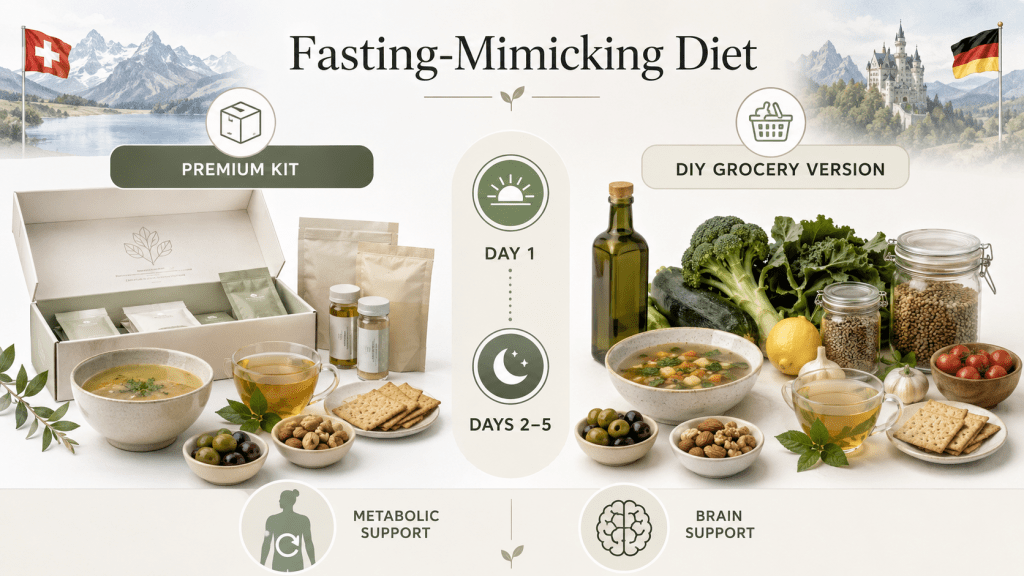
The supermarket version of a Fasting Mimicking Diet does not require speciality “longevity” foods. The useful components are largely ordinary products: nuts, olives, extra-virgin olive oil, vegetable soup ingredients, a small quantity of quinoa or crackers, herbal tea and a little dark chocolate.
What changes substantially between retailers is not nutritional sophistication but price, assortment reliability and convenience.
For comparison, the current Swiss ProLon five-day kit costs CHF 199, or CHF 173.20 per box when purchasing three under the advertised multi-box offer. The kit includes the complete pre-portioned food and supplement program.
The supermarket baskets below do not reproduce ProLon’s proprietary L-Drink, NR-3 capsules or algal-oil supplement and should therefore be viewed as FMD-style approximations rather than equivalent products.
Quick Guidefinances ranking
| Outlet | Best for | Indicative 5-day checkout | Main advantage | Main drawback | Guide- finances view |
|---|---|---|---|---|---|
| Coop | Complete one-shop basket | ~CHF 33–38 | Excellent assortment + very cheap value products | Some specialist products unnecessarily expensive | Best all-round Swiss option |
| Migros | Complete one-shop basket | ~CHF 33–38 | Strong basic range, olives, vegetables | Some “health” alternatives carry premiums | Very close second |
| Lidl Switzerland | Lowest commodity prices | ~CHF 28–35 | Cheap nuts, tea, olives, quinoa | Assortment can change | Best budget potential |
| Aldi Suisse | Pantry ingredients | ~CHF 30–37 | Excellent quinoa, olives, oil, tea | Less predictable soup/cracker choice | Strong budget option |
| Denner | Supplementary pantry shopping | ~CHF 30–40 | Good enerBiO nuts, quinoa, olives and oil | Weakest one-stop solution | Buy selectively |
| REWE Germany | Cross-border one-stop shopping | Location dependent | Excellent range and organic own-brand products | REWE does not publish one nationwide online price | Good when already shopping in Germany |
| ProLon | Maximum convenience | CHF 199 | Portioning, proprietary formulation, no shopping | Very high food cost | Premium adherence option |
The supermarket totals are editorial estimates rather than pre-packaged retailer offers. They assume approximately CHF 10–15 beyond the specifically priced pantry items for fresh vegetables, tomatoes/mushrooms, lemon, stock and a small dark-chocolate/cracker component. Actual expenditure will vary by branch and season.
Coop: best all-round Swiss basket
Coop currently offers perhaps the easiest combination of inexpensive basic ingredients and predictable nationwide assortment.
| Product | Brand / example | Current price | Why it works | Contra |
|---|---|---|---|---|
| Almonds | Prix Garantie whole almonds, 200 g | CHF 2.00 | Plain, unsalted, exceptionally inexpensive | 200 g pack encourages overportioning if not weighed |
| Peppermint tea | Prix Garantie, 50 bags | CHF 0.95 | Essentially ideal FMD tea at commodity price | None material |
| Hibiscus-style fruit tea | Prix Garantie, 50 bags; 45% hibiscus | CHF 0.95 | Cheap approximation of ProLon hibiscus tea | Contains other fruit ingredients as well |
| Minestrone vegetables | Orogel, frozen, 450 g | CHF 4.60 | Potato, carrot, tomato, courgette, cabbage, greens and other vegetables already mixed | Includes beans and peas, so portions should remain controlled |
| Quinoa crackers | Country Spelt & Quinoa, 110 g | CHF 2.95 | Convenient portion-controlled cracker substitute | Contains spelt; nutritionally different from ProLon kale crackers |
| Green olives | Coop pitted green olives, 150 g | CHF 3.20 | Simple, predictable product | Relatively salty |
| Almond-filled olives | Coop, 150 g | CHF 2.95 | Convenient higher-fat olive option | More protein than plain olives |
| Extra-virgin olive oil | Prix Garantie, 1 litre | CHF 7.95 | Outstanding price for a core FMD ingredient | A litre is far more than required for one cycle |
Coop cost
A representative core basket using almonds, peppermint tea, hibiscus-style tea, frozen minestrone, crackers, olives and one litre of olive oil costs about CHF 22.60 before fresh vegetables and miscellaneous ingredients.
Adding mushrooms, tomatoes, onions, courgettes, lemons, vegetable stock and a small dark-chocolate item brings a practical checkout into roughly the CHF 33–38 range.
Much of the olive oil, tea and possibly crackers will remain after the five days.
Guidefinances recommendation: If we want to give readers one simple Swiss shopping list, Coop is probably the easiest retailer to use.
Migros: equally practical, especially for vegetables and olives
Migros can produce almost the same basket at almost the same price.
| Product | Brand / example | Current price | Pro | Contra |
|---|---|---|---|---|
| Almonds | M-Budget almonds, 200 g | CHF 2.00 | Matches Coop’s value pricing | Must portion carefully |
| Peppermint tea | Migros Bio, 20 bags | CHF 0.95 | Organic and inexpensive | Fewer bags than Coop for same price |
| Green/garlic olives | M-Classic Chalkidiki garlic olives, 150 g | CHF 2.80 | Very convenient approximation of ProLon garlic olives | Filled product rather than simple marinated olive |
| Value olive mix | M-Budget olive mix, 150 g | CHF 1.95 | Strong price | Composition differs from branch to branch/product type |
| Minestrone vegetables | Migros Bio frozen minestrone, 500 g | CHF 4.35 | Easy soup base; larger pack than Coop example | Requires cooking and portioning |
| Quinoa crispbread | Le Pain des Fleurs Bio Quinoa, 150 g | CHF 4.95 | Simple quinoa-based crispbread | More expensive than necessary |
| Quinoa | Alnatura multicolour quinoa, 500 g | CHF 4.45 | Easy to dose directly into soup | Far more than needed |
| Olive oil | M-Budget virgin olive oil, 1 litre | CHF 7.95 | Excellent basic price | Not a premium single-origin product |
Migros cost
Using M-Budget almonds, peppermint tea, minestrone vegetables, a quinoa crispbread, garlic olives and M-Budget olive oil gives a core checkout of approximately CHF 23 before additional vegetables and chocolate.
A realistic complete checkout is therefore again around CHF 33–38.
Guidefinances recommendation: Migros is effectively tied with Coop. Choose between them based on convenience rather than making a special journey to save CHF 2.
Lidl Switzerland: lowest-cost potential
Lidl becomes particularly attractive when the objective is simply to purchase the basic commodities cheaply.
| Product | Brand / example | Current price | Pro | Contra |
|---|---|---|---|---|
| Natural almonds | Lidl natural almonds, 200 g | CHF 2.65, with recent promotional pricing as low as CHF 2.19 | Good quality commodity product | Promotions change |
| Walnuts | Lidl walnuts, 200 g | CHF 2.85 | Easy way to diversify the nut mixture | Purchasing both walnut and almond bags increases checkout |
| Premium olives | Chef Select, 150 g | CHF 1.95 | Very competitive price | Some advertised Lidl products are not permanently stocked |
| Snack olives / olive mix | 150 g | CHF 1.99 | Near-direct substitute for FMD olive portions | Availability may vary |
| Peppermint tea | 50 bags | CHF 0.95 | Same excellent value as Coop | None material |
| Fruit/hibiscus-style tea | 50 bags | CHF 0.95 | Extremely inexpensive | Verify ingredients if specifically seeking hibiscus |
| Organic quinoa | White/tricolour, 400 g | CHF 3.55 | Cheapest verified quinoa in this comparison | Lidl customer comments indicate availability has occasionally been inconsistent |
| Italian olive oil | 500 ml | CHF 6.49 | Smaller bottle reduces unused checkout cost | Not necessarily permanent in every branch |
Lidl cost
A core basket of almonds, two olive packs, peppermint tea, quinoa and 500 ml olive oil comes to approximately CHF 17.50.
Adding vegetables, mushrooms, tomato ingredients, crackers and a little dark chocolate puts a practical complete basket around CHF 28–35.
Guidefinances recommendation: best potential Swiss budget option, provided the relevant products are actually in stock.
The saving versus Coop or Migros is real but modest in absolute terms. We are discussing perhaps CHF 5–10, not hundreds of francs.
Aldi Suisse: strongest discount-store alternative
Aldi’s permanent range is particularly good for quinoa, olive oil, tea and olives.
| Product | Brand / example | Current price | Pro | Contra |
|---|---|---|---|---|
| Whole almonds | Happy Harvest, 200 g | CHF 2.65 | Straightforward natural nut base | Coop/Migros value almonds are cheaper |
| Almond-filled or garlic olives | Lyttos Greek olives, 200 g | CHF 1.99 | Excellent price and suitable flavours | Filled varieties differ from ProLon’s simple olives |
| Organic marinated olives | 150 g | CHF 1.99 | Very inexpensive | Herb marinade alters composition slightly |
| Organic quinoa | White or tricolour, 450 g | CHF 3.99 | Permanent assortment and competitive price | Much more quinoa than required |
| Peppermint tea | Retour aux Sources Bio, 20 bags | CHF 1.25 | Swiss-grown organic peppermint | More expensive than Lidl/Coop tea |
| Olive oil | Solesta, 1 litre | CHF 7.95 | Permanent assortment and low price | Large bottle |
| Extra-virgin Greek olive oil | Lyttos, 500 ml | CHF 5.49 | Better-sized FMD purchase and extra-virgin | Slightly higher litre price |
| Dark chocolate | Moser Roth 70%, 125 g | CHF 1.75 | Excellent small Choco-Crisp ingredient | Must be portioned carefully |
Aldi cost
Using almonds, two packs of olives, quinoa, peppermint tea, 1 litre of olive oil and dark chocolate produces a verified shelf subtotal around CHF 21.50.
With fresh vegetables and a cracker component, approximately CHF 30–37 is a reasonable checkout target.
Using the smaller CHF 5.49 Greek extra-virgin oil instead of the litre bottle can reduce initial checkout slightly.
Guidefinances recommendation: Aldi is arguably the best discount supermarket for a deliberately planned basket, while Lidl may win when individual promotions line up.
Denner: good components, weaker one-stop shop
Denner is more interesting than it initially appears because its expanding enerBiO assortment now covers several important FMD ingredients. It is nevertheless less convenient for recreating the entire program.
| Product | Brand / example | Current price | Pro | Contra |
|---|---|---|---|---|
| Nut mixture | enerBiO roasted, unsalted nut mix, 150 g | CHF 2.95 | Unsalted mixture is highly convenient | Mixed nuts make precise nutritional matching harder |
| Quinoa | enerBiO Tricolore, 500 g | CHF 4.45 | Organic, predictable product | Large pack |
| Olive mix | enerBiO olive mix with herbs, 180 g | CHF 3.40 | Convenient ready-to-use portion source | More expensive than Aldi/Lidl olives |
| Black olives | Dumet Spanish, 150 g | CHF 2.70 | Reasonable pantry option | Black rather than the green olives typical of ProLon |
| Extra-virgin olive oil | enerBiO Greek, 500 ml | CHF 7.95 | Bio and conveniently sized | Considerably more expensive per litre than Coop/Aldi value oil |
| Premium nut mix | Denner Edelnussmischung, 150 g | CHF 3.50 | Easily available | Roasted and salted; not our preferred FMD choice |
Denner cost
The verified enerBiO nut mix, quinoa, olive mix and 500 ml olive oil already total approximately CHF 18.75.
Once herbal tea, soup vegetables, tomato ingredients, crackers and chocolate are sourced, a complete basket will probably land around CHF 30–40.
The problem is not necessarily price. It is assortment.
Guidefinances recommendation: buy the excellent enerBiO pantry products if Denner is convenient, but do not make Denner the default one-stop FMD store. It is easier to finish the basket at Coop or Migros.
REWE Germany: strong selection, but no honest nationwide price
For readers around Basel, Schaffhausen, Konstanz or other border regions, Germany naturally raises the question of cross-border grocery arbitrage.
REWE has an excellent suitable assortment, including:
| Product | Brand / example | Published online price | Pro | Contra |
|---|---|---|---|---|
| Almonds | REWE Bio Mandeln, 200 g | Location dependent | Easy organic nut option | No single German online price |
| Green olives | REWE Bio green pitted olives, 180 g | Location dependent | Very simple ingredients: olives, water, salt, lactic acid | Price requires store selection |
| Garlic olives | REWE Beste Wahl marinated olives with garlic, 150 g | Location dependent | Convenient direct substitute | Marinade varies |
| Tomato soup | REWE Bio tomato soup, 375 ml | Location dependent | Vegan; only 0.8 g protein/100 ml | Relatively high salt: 1.1 g/100 ml |
| Organic soups | REWE Bio and other organic brands | Location dependent | Wide selection | Ready-made soups vary considerably in calories, protein and salt |
| Quinoa | REWE Bio varieties | Location dependent | Broad German organic assortment | Exact local price needed |
REWE’s own shop explicitly states that concrete prices depend on the selected location, so publishing a fictitious “German REWE price” would create false precision.
REWE cost
Guidefinances recommendation: do not publish a fixed REWE basket total.
Instead, tell German or cross-border readers to select their local REWE and compare the live basket. Availability is excellent; the precise saving depends on location.
For a Swiss resident, Germany makes the most economic sense when the REWE trip is already part of normal grocery shopping.
Driving across the border solely to save several francs on five days of intentionally inexpensive food is not particularly sophisticated financial optimisation.
Which products deserve the cheapest version?
There is little reason to pay a premium for:
- peppermint tea;
- hibiscus tea;
- plain quinoa;
- frozen vegetables;
- ordinary green olives;
- almonds;
- basic vegetable stock.
The retailer’s value brand is generally sufficient.
Extra-virgin olive oil deserves slightly more attention because flavour and quality vary, but the quantities consumed during five days remain small. Even here, buying a CHF 25 bottle specifically for an FMD is difficult to justify when credible supermarket options cost CHF 5–8.
Where a premium can make sense
There are three places where spending more can rationally improve the experience.
Better olives: because they represent an actual snack rather than merely an ingredient, flavour matters.
Better soup ingredients: fresh vegetables and homemade soups may make the five-day program substantially easier to tolerate than repetitive powdered soup.
Pre-portioning: this is precisely where ProLon has its strongest advantage.
The important financial principle is that the food itself is cheap; removing decisions is expensive.
Final cost comparison
| Strategy | Approximate initial cost | What remains afterwards | Conve-nience | Protocol fidelity |
|---|---|---|---|---|
| Lidl DIY | ~CHF 28–35 | Oil, tea, quinoa, possibly nuts | Medium-low | Low |
| Aldi DIY | ~CHF 30–37 | Oil, quinoa, tea | Medium-low | Low |
| Coop DIY | ~CHF 33–38 | Oil, tea, crackers | High for DIY | Low |
| Migros DIY | ~CHF 33–38 | Oil, tea, quinoa/crackers | High for DIY | Low |
| Denner DIY | ~CHF 30–40 | Oil, quinoa | Medium-low | Low |
| REWE DIY | Local price required | Depends on basket | High | Low |
| ProLon Switzerland | CHF 199 | Virtually nothing | Very high | Highest |
A CHF 30–40 supermarket checkout therefore costs roughly 80% less than a CHF 199 ProLon box, although this is not a like-for-like product comparison: ProLon adds pre-portioned foods, proprietary components and considerably greater standardisation.
For a disciplined user who is comfortable weighing food, the supermarket economics are difficult to ignore.
For someone who knows that unrestricted packets of nuts, crackers and chocolate tend to become unrestricted portions, paying for the box may be rational.
The cheapest ingredients do not produce the cheapest successful protocol if portion control fails.
Guidefinances shopping recommendation
For most Swiss readers:
Best overall: Coop or Migros — easiest to execute correctly in one visit.
Best pure value: Lidl or Aldi Suisse — lowest likely checkout when the appropriate products are available.
Best selective pantry option: Denner enerBiO — good nuts, quinoa, olives and olive oil, but incomplete as a one-stop solution.
Best cross-border option: REWE — if Germany is already part of the normal shopping routine.
Best convenience: ProLon — expensive relative to the underlying ingredients, but the premium buys standardisation and adherence rather than merely food.
Prices and online assortments were checked on 11 August 2026. Promotions, branch availability and supermarket prices can change. DIY basket totals are editorial estimates based on the cited shelf prices plus an allowance for fresh vegetables and other small ingredients; they are not retailer package prices.
Continue with Guidefinances
Explore the broader longevity guide: exercise, sleep, nutrition, preventive check-ups, brain health and practical longevity tools. Health & Longevity →
Finance the long term. Good health habits are often inexpensive, but decades of retirement, healthcare and prevention still need financial resources. A few tools covered by Guidefinances:
Interactive Brokers → long-term investing
Swisscard Cashback → FC40XCUXX
neon → 5CN4N6
Some links are referral or affiliate links. Conditions may change; editorial assessments are independent of compensation.

